Pamela May

Pamela May was a dancer of great classical purity and belonged to the famous early generation of Royal Ballet dancers who blazed a trail for theatre dance in Britain. Born in Trinidad, 30 May 1917, she joined the Sadler‘s Wells Ballet School at the age of fifteen, joining the Vic-Wells Ballet in 1934. Ninette de Valois and Frederick Ashton created many roles for her and she was in the historic first cast of Ashton‘s “Symphonic Variations“ in 1946.
In the ballerina roles of the standard repertory she was outstanding as Odette/ Odile and Aurora but is remembered by many for her assumption of the role of Swanilda in “Coppélia“ where her command of classical mime and gift for comedy were utilised to great advantage. Although she retired from ballerina roles in 1952 she continued to dance as a character artist for another thirty years. Although she was an extremely versatile ballerina – as many dancers of her period needed to be – she was outstanding for her energy, vivacity and purity of line. She died aged 88, on 6 June. Monica Mason, Director of the Royal Ballet said, “she has been part of our lives, not only as a ballerina, but as a teacher at the Royal Ballet School and as a ...
Weiterlesen mit dem digitalen Monats-Abo
Sie sind bereits Abonnent von tanz? Loggen Sie sich hier ein

- Alle tanz-Artikel online lesen
- Zugang zum ePaper
- Lesegenuss auf allen Endgeräten
- Zugang zum Onlinearchiv von tanz
Sie können alle Vorteile des Abos
sofort nutzen
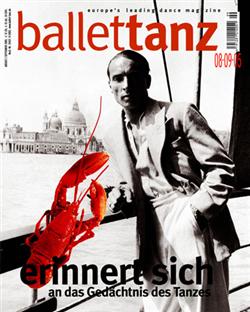
Hummeralbträume
TANZEN HEISST, ATLANTIS AUF DEM RÜCKEN EINES RIESENKREBSES ZU DURCHQUEREN
Sehr geehrte Frau Leichtentritt, nachdem ich zufällig in Poitiers bei meinem balletomanen Zahnarzt auf eine ganze Sammlung alter Ausgaben ihrer Tanzzeitschrift gestoßen war, machte ich mich mit Erstaunen daran, Ihren faszinierenden Artikel über George Balanchine und dessen...
Donna Uchizono is an intelligent choreographer who can create intoxicatingly beautiful dances, but whose conceptual underpinnings sometime overwhelm her deliberate, often introverted movement. “Approaching Green,” a premiere performed at New York’s Danspace Project, was packed with so many ideas and production elements that the dancing wound up playing a supporting...
Der Kern der Tanzgeschichte, also der Tanz, ist abwesend. Sobald Tanz aus der Gegenwart fällt, ist er nur noch im Gedächtnis abrufbar, in der Körper-Erinnerung von Tänzern und Betrachtern, im Foto, in der Notation, im Video oder in der Kritik. Die Substanz des Tanzes, das Tanzen dagegen, ist nur präsent im Moment der Bewegung. Insofern ist der Gegenstand der...