Kim Brandstrup

Kim Brandstrup is to perform at The Royal Ballet in London a new ballet in the spring using a “lost” Prokofiev score. The music was written in 1936 for a film of “The Queen of Spades” to be made by Mikhail Romm. Political interference in the arts during the Stalinist era prevented that. Prokofiev’s later scores for “Alexander Nevsky” and “Ivan the Terrible” contributed to the classic status these Sergei Eisenstein movies now enjoy. Some would contend that Prokofiev wrote with more natural facility for the movies than for the ballet stage.
The Danish choreographer Kim Brandstrup was reading an article by an American biographer about Prokofiev and, as reported in The Times of London “saw in the footnotes that he had part written this film score and that it was in a Moscow archive. Then I found that a photocopy was at the department of Music at Goldsmiths, University of London.” After looking at the fragmented and unfinished score, Brandstrup approached Monica Mason, Director of the Royal Ballet and suggested a ballet based on the music. She suggested the composer Michael Berkeley, with his long association with the Royal Opera House, as a suitable person to arrange the score. The ...
Weiterlesen mit dem digitalen Monats-Abo
Sie sind bereits Abonnent von tanz? Loggen Sie sich hier ein

- Alle tanz-Artikel online lesen
- Zugang zum ePaper
- Lesegenuss auf allen Endgeräten
- Zugang zum Onlinearchiv von tanz
Sie können alle Vorteile des Abos
sofort nutzen
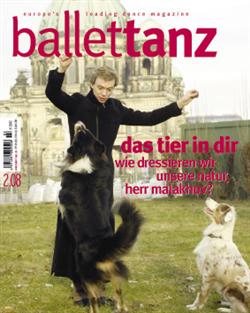
Tanztherapeuten sind immer auf der Suche nach dem Menschlich-Allzumenschlichen. Sie suchen die «Animalität», das Tier, das fast wortgleich auch die Seele (Anima) und die Bewegung (Animé) meint. Alles drei steht in einer sehr alten verwandtschaftlichen Tradition. Schon der Grieche Aristoteles fasst den Menschen als Einheit von Körper und Seele auf, um so zwischen...
John Neumeier choreografierte den Eingangs-Chor des «Weihnachtsoratorium» so euphorisch, als wollte er damit geradewegs den Himmel erstürmen. «Jauchzet, frohlocket», hieß es bei der letzten Premiere des Hamburg Ballett in Erwartung des Herrn. Ein Unbekannter ist er dort nicht. Mit der «Matthäus-Passion», mit dem «Magnificat», Händels «Messias» und Mozarts...
Wo genau verläuft die Grenze zwischen Mensch und Tier? In Mythen und Sagen, in den frühesten Zeugnissen von Ritual und Kunst, in der Geschichte des Wissens ist sie unscharf. Nur in der Bibel ist die Beziehung noch klar: Adam im Paradies, als Ebenbild Gottes, gibt den Tieren ihren Namen. In dieser Weise herrscht er über sie – doch schon Thomas von Aquins Kommentar...