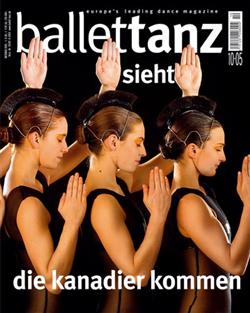
Canadians in Europe

The list of international applicants was impressive and it is to Wayne Eagling’s credit that he has now secured this important post: becoming the new leader of English National Ballet, Britain’s largest touring company. His tenure at the Dutch National Ballet has given him the experience of running a major national company and may have proved the deciding factor in his appointment. His association with Britain is a long one, although he is Canadian by birth and spent his youth in California.
Michael Somes and Gerd Larsen discovered him when the Royal Ballet was touring the USA in 1965 and they invited him to complete his training at the RBS in London. Wayne Eagling joined the Royal Ballet in 1969 and worked with the great choreographers Frederick Ashton and Kenneth MacMillan who created roles for him. He attained Principal status in 1975 and danced all the major classical roles before his retirement from the stage in 1991, when he succeeded Rudi van Dantzig as Artistic Director of the Dutch National Ballet. His first major choreography, “Frankenstein,“ the Modern Prometheus, was made for the Royal Ballet in 1985 and subsequently mounted for Amsterdam and Milan. His most recent ...
Weiterlesen mit dem digitalen Monats-Abo
Sie sind bereits Abonnent von tanz? Loggen Sie sich hier ein

- Alle tanz-Artikel online lesen
- Zugang zum ePaper
- Lesegenuss auf allen Endgeräten
- Zugang zum Onlinearchiv von tanz
Sie können alle Vorteile des Abos
sofort nutzen
In David LaChappelle’s documentary, Rize, the pent-up rage of kids from Los Angeles’ South Central bursts off the screen and grabs you by the throat. But instead of violence, the anger takes shape in the exhilarating new dance forms called krumping and clowning. Clowning was invented out necessity and providence by an ex-drug dealer, Thomas Johnson (Tommy the...
Imagine a selection of drawings, scores, instructions or sketches created by choreographers during the process of making dances, e. g. Trisha Brown, Yvonne Rainer, Dominique Bagouet, Remy Charlip, Mary Wigman, William Forsythe and Elisabeth Streb. How might we conceive of these as representations of choreographic thinking or as carriers of moving ideas? How would...
Over the last century dance has traveled from continent to continent, shifting its focal points of creativity and intensity. Historically, the fluctuating cartography situates long traditions in Berlin, Paris, and London. In the mid-1980s rejuvenation occurred in places like Brussels, Ljubljana, Barcelona, and Montéal. Guy Cools, the former dance programmer and...