Ideas for the theatre of the future

From 3 to 5 June, some 300 specialists from all over the world met in Savoy Place, the seat of the 1871-founded Institution of Engineering and Technology (IET), to discuss tendencies in theatre engineering and technology. ‘Places for performance – new directions’ was the motto of this year’s conference, which offered a compellingly varied programme.
As in previous years, the 5th edition of ITEAC was organized by the Association of British Theatre Technicians.
ABBT chairman Robin Townley sat on the editorial board, responsible for curating and preparing the event, with David Staples as chairman, who put together the eight-person team.
The very setting of the conference provided food for thought and a feast for the eyes. Savoy Place is an opulent building on the bank of the Thames, opposite the National Theatre and the Royal Festival Hall, and has been the seat of the IET, originally an association of telegraph engineers, since 1909. The premises were recently refurbished at a cost of around 30 million euros, transforming the venerable building into a modern congress centre which is used daily thanks to its on-site library and other IET facilities.
Focus on people
A central issue to be discussed, then, was how to plan major construction projects with people in mind, rather than presenting people with buildings they are forced to live around. Dutch architect Francine Houben – the first keynote speaker – talked through her approach to such large-scale projects by the example of the soon-to-be completed Kachsiung Arts Center in Taiwan, a major arts centre with four halls for opera, concerts, theatre and dance.
Old and new
Learning from the past is essential. So, what has been tried and tested and proven its worth? What has turned out to be counter-productive and should be avoided? David Staples has examined key aspects of prominent theatre buildings of the 20th century for the book ‘Modern Theatres’. Some of these, and several others, were presented in a fast-paced review entitled ‘Lessons from the 20th century’. In 90 minutes, 11 speakers presented a total of 14 projects, devoting only three, strictly counted minutes to each. Common themes of the projects were then highlighted by the university lecturer and author Alistair Fair (‘Modern Playhouses’, BTR 3/2018), who is also a gifted moderator. He not only pointed out the various influences behind them but also showed that, in many cases, functionality and aesthetics are not equal partners. The best example is, and probably always will be, the Sydney opera house.
How can we make existing theatres fit for the 21st century? Panellists discussed this question with theatre architect Tim Forster, focussing on ways of adapting old theatres to contemporary modes of performance and operation.
Built for the future
Thanks to ITEAC’s international reach, it has access to source-information about many contemporary lighthouse projects. Project leader Ascan Mergenthaler, partner at Herzog & De Meuron, talked about the Elbphilharmonie in his keynote address, and the planners’ strategy of taking inspiration for their design from the site and surroundings. Their vision has now become reality. Liz Diller, one of the few internationally renowned female architects, profiled ‘The Shed’, which – despite the name – is a spectacular project set to become another lighthouse for New York.
Acoustics play an increasingly important role in planning, with standards steadily rising. Several recently completed concert halls provided illustrative material for examining the relationship between architecture and acoustics. Moderator Christopher Blair, director of AKUSTIKS USA, opened the survey by presenting some projects currently in progress, which were discussed in detail later. A session titled ‘New Theatres Showcase’ highlighted the range of possibilities for theatre-building, to suit every need.
‘Theatre in motion’ focused on the variants of a theatre type that is currently booming: Structures that can be easily and more-or-less cheaply assembled and dissembled, intended for temporary use during renovation periods or for major touring productions.
What is the ideal theatre?
This question is always raised at the beginning and end of every discussion about theatre engineering. It ran through the ITEAC’s programme like a red thread, going in diverse thematic directions and even provocatively challenging the very point of permanent theatres. The potential of digital technologies to revitalize theatre was explored in several of the talks and discussions. Aspects of ‘digital interaction in analogue spaces’ was a theme of many of the lectures.
But the question of what makes an ideal theatre was not answered. Rightly so, as there is no one ideal, and theatre cannot be neatly compartmentalized. The farewell get-together was as informal as ever but held on the exclusive roof of Savoy Place, with spectacular 360° views of London.
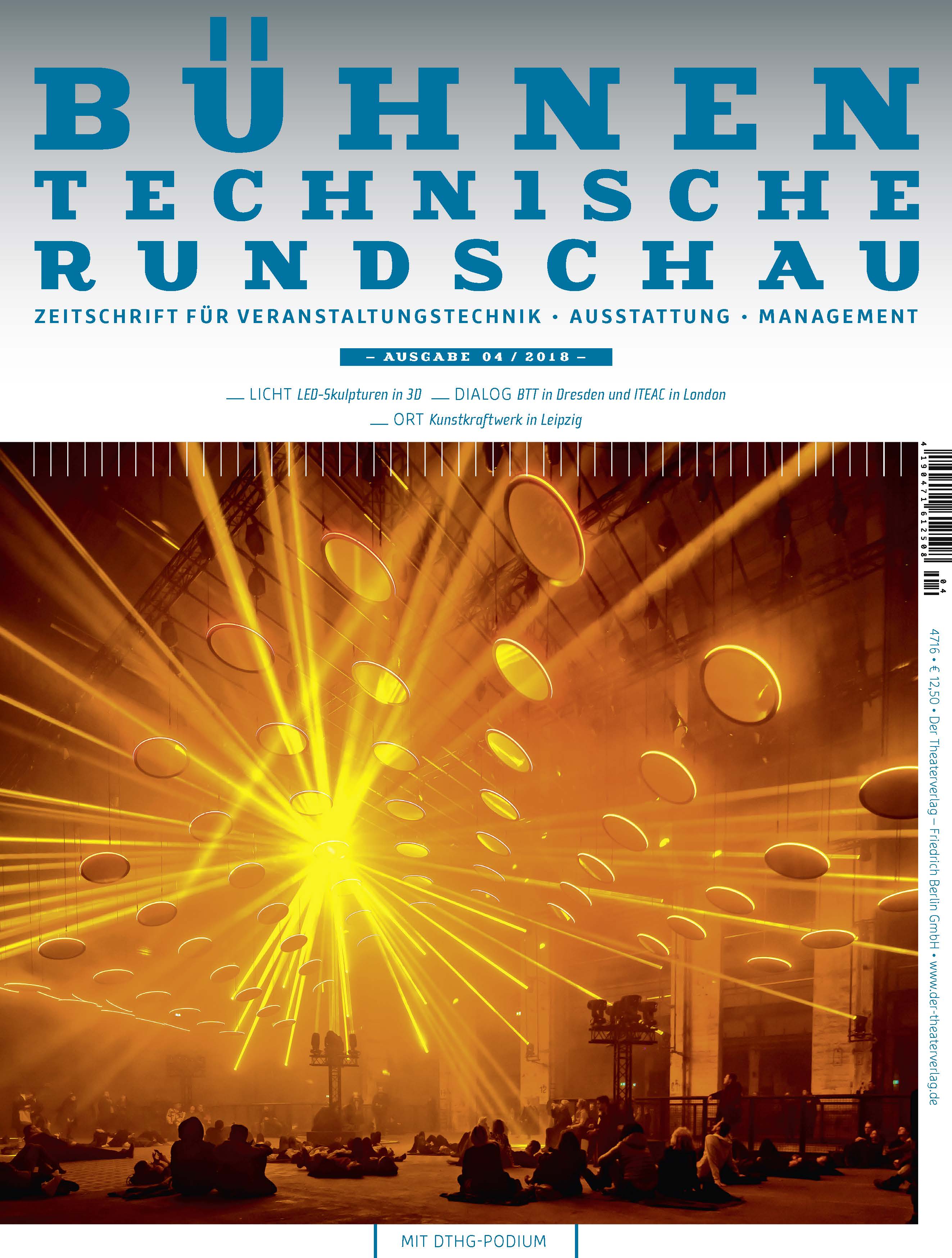
BTR Ausgabe 4 2018
Rubrik: English texts, Seite 220
von Karin Winkelsesser
Neues aus der Branche zur Tonmeistertagung des vdt
Vom 14. bis zum 17. November lädt der VDT zur 30. Tonmeistertagung nach Köln ein. Dazu berichten wir über aktuelle Entwicklungen, die auch in den Fachkonferenzen Beachtung finden werden. 3D-Sound-Systeme sind ein aktuelles Thema, sie werden immer mehr im Theater angewendet. In Konzerthallen werden raumakustische Konzepte im...
Atlas zum Städtebau
Band 1: Plätze; Band 2: Straßen
von Markus Tubbesing, Vittorio Magnago Lampugnani, Harald Stühlinger (Hrsg.)
2 Bände mit insg. 732 Seiten
1600 überw. farb. Abbildungen
je Band 25,5 × 34,4 cm · gebunden mit Lesebändchen
ISBN 978-3-7774-2966-3
Hirmer Verlag, München 2018
EUR 98,00 / SFR 116,00
Die vorliegende zweibändige Publikation stellt 68 der städtebaulich wichtigsten...
Wozu brauchen Szenografen, Bühnentechniker und -architekten einen internationalen Dachverband? Vertreter aus sieben Ländern kamen 1968 in Prag zusammen und gründeten mitten im Kalten Krieg die OISTT, jetzt OISTAT. Die politische Situation hat sich verändert, aber das Ziel des fachlichen Austauschs bleibt aktuell. Dr. Joel Rubin war der zweite Präsident der OISTAT, von 1972 bis 1978. Er...