Revival
How can we keep theatre history alive, or perhaps even revive it? In this issue, we look at a range of different projects that offer possible answers. First, feast your eyes on photographs and historical drawings illustrating the opulence of baroque theatre: in this case, the Markgräfliche Opernhaus in Bayreuth, built in 1748, which reopened in April after renovation. This involved the reconstruction – and re-interpretation – of an alley stage after a design by Carlo Galli da Bibiena.
A lot of wood was used in the Markgräfliche Opernhaus and elsewhere, too, this classic material is enjoying a revival. In Avignon, an entire theatre has been made of wood – as a substitute venue for the town’s opera house, which is currently under renovation. For reasons of both economy and historical interest, the seating was sourced from various European opera houses, lending the auditorium a special, recycled charm. It’s partly thanks to improved fire safety precautions that wood is back in demand as a building material for opera houses. But they can also have negative consequences, as the recent floodings have shown – an issue we continue to investigate. This month, we traced how the current regulations came about; read on for an overview.
A tendency toward old classics can be observed not only in theatre construction but also in productions. Classic plays and ancient themes are being used as templates for exploring contemporary issues, as demonstrated at this year’s Theatertreffen in Berlin. Age-old legends such as The Odyssey and the myth of Oedipus reveal striking contemporary relevance when set in modern contexts.
In an insecure world, historical material seems to provide stability. Stage sets play an important role here, as a current production of “Woyzeck”, with a crucial tilting and revolving stage, shows. But smaller format productions such as “Trommeln in der Nacht” (depicted on the cover) also demonstrate the potential of stage sets for combining the historical and the contemporary. And a current exhibition on the history of pop music takes revival as its mission, rousing visitors’ memories of their own musical experiences in a colourful show.
The past is also an important reference point for both the German stage technicians’ society DTHG and us at BTR, having recently celebrated our 111th anniversaries at the stage engineering conference in Dresden. Read about the event in the enclosed copy of “Podium”. But, of course, the main focus is on what’s ahead, both here and in the current issue of BTR, so let’s take things forward together.
The editors
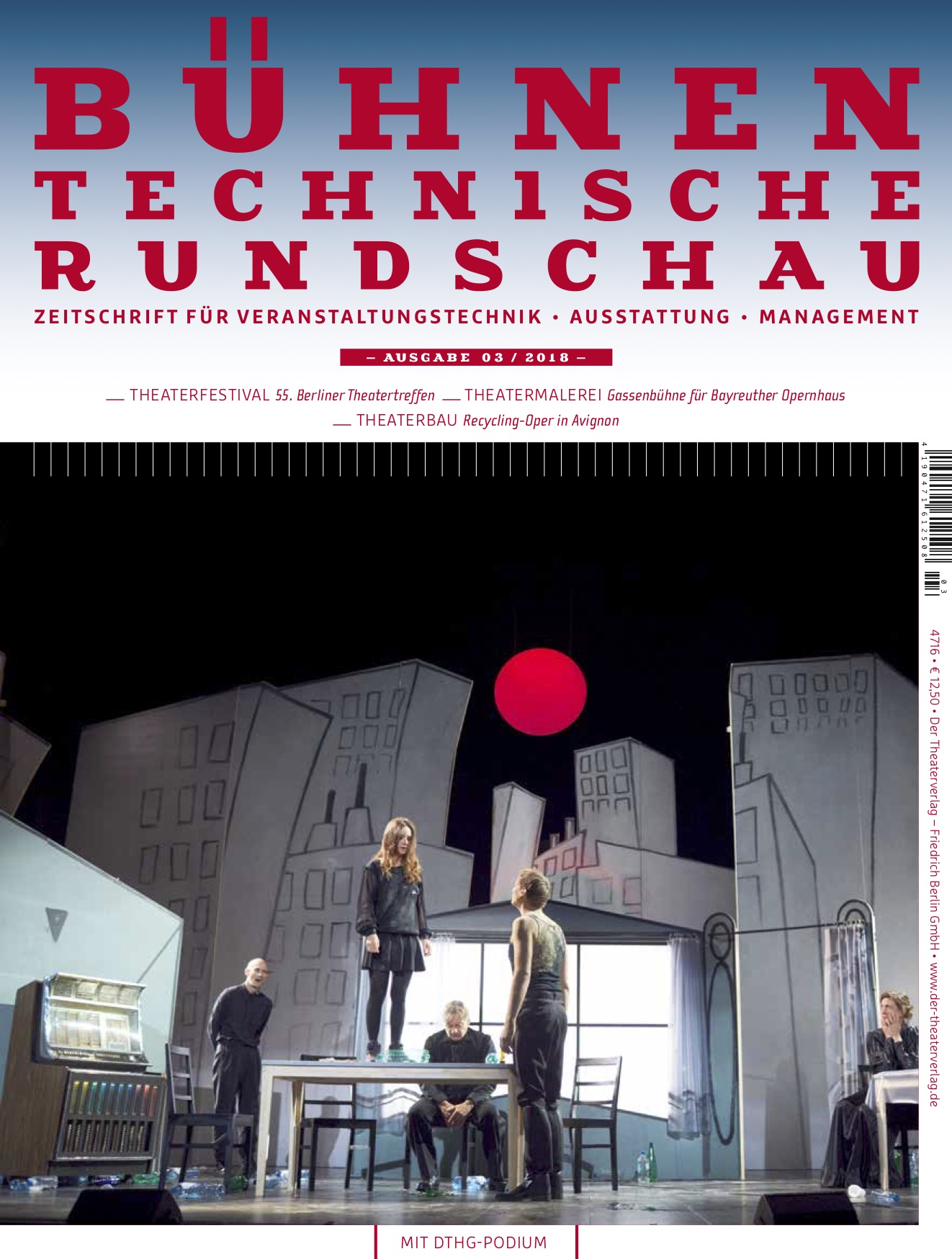
BTR Ausgabe 3 2018
Rubrik: English texts, Seite 201
von
Wie wird Theatergeschichte lebendig erhalten oder wiederbelebt? Dazu stellen wir in dieser Ausgabe Projekte aus ganz unterschiedlichen Bereichen vor. Eingangs dürfen Sie sich an opulenten Aufnahmen und historischen Zeichnungen zur Fülle des Barocktheaters erfreuen: Das Markgräfliche Opernhaus Bayreuth von 1748 wurde im April wiedereröffnet. Im Zuge der Sanierung für den Museumsbetrieb ist...
Gemäß Musterbauordnung § 14 sind bauliche Anlagen so anzuordnen, zu errichten, zu ändern und instand zu halten, dass der Entstehung eines Brandes und der Ausbreitung von Feuer und Rauch vorgebeugt wird und bei einem Brand die Rettung von Menschen und Tieren sowie wirksame Löscharbeiten möglich sind. Aus gegebenem Anlass unbeabsichtigter Fehlauslösungen von Löschanlagen hat der Autor eine...
Der Gasometer in Oberhausen ist bekannt für seine großformatigen Kunstprojekte. Daneben bietet er aber auch immer wieder Raum für thematische Ausstellungen aus den Bereichen Natur und Technik. Gegenwärtig hängt eine Skulptur des Matterhorns kopfüber in der 117,5 m hohen Halle und ist das Herzstück der Ausstellung „Der Berg ruft“. Unsere Autorin ist dem Ruf gefolgt und hat den...