Mats Ek: "Orphée"

The dance-opera “Orphée” by Mats Ek for the Swedish Royal Opera is an excit-ing interpretation of the Greek myth of Orpheus and Eurydice based on Gluck’s opera “Orphée,” created in 1762 and revised by Berlioz in 1859. The score is honourably interpreted by conductor Sir Richard Armstrong and the Swedish Royal Opera Orchestra.
The stage set is by artist Marie Louise Ekman, who designed the sets for all of Ek’s best known ballets. This time she has created an opening stage set dominated by a big empty oval, flanked by two head stones.
The atmosphere of serene emptiness is both soothing and painful and a strong symbol of the desolate mental state in which Orphée (Anne Sofie von Otter) finds himself. Von Otter is a magnificent singer, not a dancer, but her physical portrait of Orphée is very convincing. With the help of Ek’s directions and Ekman’s designs, she transforms herself into a dishevelled middle-aged man with the appearance and stiff movements of someone who is barely alive.
The opera takes the perspective of Orphée, and it is through his eyes that Eurydice (Marie Arnet) is seen, who turns out to be as full of life as he is lacking in it. In effect the opera is a portrayal of ...
Weiterlesen mit dem digitalen Monats-Abo
Sie sind bereits Abonnent von tanz? Loggen Sie sich hier ein

- Alle tanz-Artikel online lesen
- Zugang zum ePaper
- Lesegenuss auf allen Endgeräten
- Zugang zum Onlinearchiv von tanz
Sie können alle Vorteile des Abos
sofort nutzen
Ein weißer Ballon schwebt am Bühnenhimmel, eine Elfe müht sich eine Treppe hoch, ein Mädchen erklimmt Stufen, greift nach Erkenntnis. So strebte der Barockmensch nach oben. Erforschte das Sonnenlicht, die Gravitation, das Weltall. Als Zeit des Wissensdrangs, aber auch als Zeit des Scheiterns begreift Amanda Miller die Epoche der Geburt des Balletts. Als so filigran...
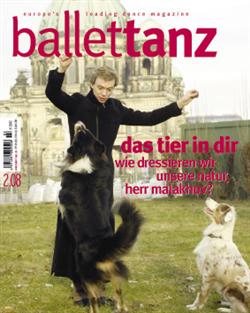
The Animal Theatre Manifesto
By Wayn Traub
1. The animal is the beginning and end of animal theatre. It is both the source and the aim.
2. Animal theatre is born of a deep desire, the cry of the animal in each of us (animus). The creator transforms this desire into action (animer) and if his performance is successful, the animal in man is aroused (animal). Theatre...
Das Tier ist ein Freund sagt man, wenn es ein Haustier ist. Es gibt auch Stall-Tiere, die als weniger lieb gelten, nur, weil sie irgendwann gegessen werden. Und es gibt wilde Tiere, doch die sterben aus. Darum stellt jeder neugeborene Eisbär, ob in Berlin oder in Nürnberg, nichts anderes dar als den «lieben Wilden». Der kleine Bär wird zum Pop-Star. Das ist ein...