Bodies of Color

Historians credit Hélio Oiticica and his 1967 Tropicália exhibition in Rio de Janeiro with triggering an explosion of cultural upheaval, soon to be suppressed by years of military dictatorship in Brazil. While the music of Gilberto Gil and Caetano Veloso, and the movement that became known as Tropicalismo, continued to have a lasting influence on world music ever since, the groundbreaking aspects of ‘nova objetividade brasileira’ in the visual arts were largely undervalued.
Hélio Oiticica’s work, alongside that of fellow contemporary artist Lygia Clark, first resurfaced at the 1997 documenta in Kassel, where it caused stunned reactions. Why had it taken so long for curators to (re)discover these Latin American artists whose radical conceptual and performative ideas offered a unique articulation of modernism through (and post) abstraction?
Now Hélio Oiticica (1937-1980) is considered a major player. His and Clark’s incorporation of time and the sensate body at the center of their inventions gives them broad international significance and casts new light on past decades of performance and hybrid art practices. Their work comments in a unique way on today’s aesthetic debate on ...
Weiterlesen mit dem digitalen Monats-Abo
Sie sind bereits Abonnent von tanz? Loggen Sie sich hier ein

- Alle tanz-Artikel online lesen
- Zugang zum ePaper
- Lesegenuss auf allen Endgeräten
- Zugang zum Onlinearchiv von tanz
Sie können alle Vorteile des Abos
sofort nutzen
“Everything has its time and the time when I had great physical strength is gone; I have to use the possibilities I have now.” For Ana Laguna, born in Zaragoza in 1954, and living in Sweden, expressing herself in movement is as vital and as natural as ever. But “the possibilities that I have now are different compared to those I had when I was young.”
Fortunately,...
Sidi Larbi Cherkaoui erschuf das Universum im Jahr 2000. Mit seinem «Rien de rien» begann der erste Tag. Aus dem Nichts entstand die Religion. Und siehe, da es nur einen Schöpfer, aber unzählige Weisen zu glauben gibt, sahen Gott und Sidi Larbi Cherkaoui, dass der Glaube der Vater aller Kriege ist. So geschah es, dass der marokkanische Sohn einer belgischen Mutter...
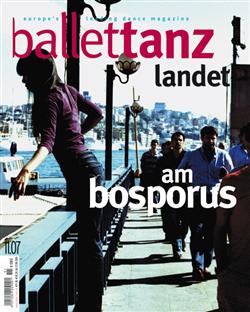
In den Kinos läuft Fatih Akins «Auf der anderen Seite». Der Film zeigt einen Totenhandel zwischen Bremen und Istanbul. Eine türkische Gegnerin des türkischen Staats wird von der deutschen Justiz an ihr Land ausgeliefert, das sich gefälligst an die EU-Normen eines Rechtsstaats halten soll. Die ihr zu Hilfe eilende deutsche Geliebte wird in Istanbul auf offener...