Exterior dance

Urban Art is public art. Whether you are counting in sculptures in a park or a dance company’s act on a market place – art is examining our societal environment as well as our relationship with art and the real.
Of course, we dream – and how much the very word “dance” stirs the imagination – of a new Rimbaud who “stretches ropes from steeple to steeple,” or the unpredicted outbreak of drunken maenads in the conforming and ordinary city.
Dancing the city and dancing life; what a utopia! Sometimes, however, a show can shake the landscape around it and create a temporal parenthesis, suspended in the urban tumult. Sometimes the path of a few dancers may also disturb our functional routine, and make us suddenly attentive of the matter of which ground and wall are made, in accordance with our physical bodies in the surrounding space, and to the emptiness of its hindrances. In short, it gives us a taste of freedom. Perhaps this is a function of art regardless of the place.
Choreographer Daniel Dobbels expresses this more gravely, more politically when he writes, “A dancer cannot dance without having within himself the hope that all bodies might also be free to move.”
By venturing out to ...
Weiterlesen mit dem digitalen Monats-Abo
Sie sind bereits Abonnent von tanz? Loggen Sie sich hier ein
- Alle tanz-Artikel online lesen
- Zugang zum ePaper
- Lesegenuss auf allen Endgeräten
- Zugang zum Onlinearchiv von tanz
Sie können alle Vorteile des Abos
sofort nutzen
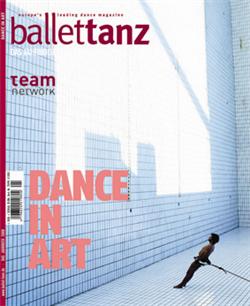
Live art is by nature a territory where dance flirts with the visual arts. The artists mentioned here, Steven Cohen and Janez Jansa/Maska, work on those fringes. Their work was presented at the festival Trouble which, each year in the Halles of Schaerbeek in Brussels, shakes the establishment and allows interaction with artists from the visual arts, like Myriam...
“We all wanted to become ballet dancers, football players, astronauts, where did we go so wrong?” Berlin’s theatre group Gob Squad asked in one of their shows. The action had the group’s members sit from nine to five behind desks in a slick office building. With the professional smiles of financial advisers, they revealed the labour market’s ugly strategies to...
Tänzer des Jahres
sind Sylvie Guillem und Raimund Hoghe. Man kann sich kaum einen größeren Kontrast vorstellen, nicht bloß, was die Körpergröße betrifft.
Sylvie Guillem
überzeugte, ja überraschte in den Duetten «Push» mit Russell Mali-phant und «Sacred Monsters» mit Akram Khan, weil sie die klassische Linie ganz entspannt durch die längst offen stehende Tür zum...