kissing horses

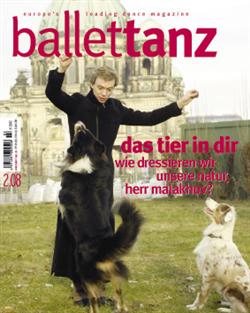
When the curtain lifts on Cavalia, a woman and a gelding stand on a stage covered in sand. They appear to be strangers to one another – fine representatives of their species and sexes, reflected in the pool of water between them. But when the woman moves, the horse responds and when the horse moves, the woman responds. She offers him water from her hand, he drinks. Gradually, this tentative reciprocal play turns into an interactive dance in which the two bodies become absolutely complementary and logical in their togetherness.
“Cavalia” is a multi-media spectacle that combines circus acrobatics, dressage, dance and music, and features 35 two-legged and 50 four-legged performers. Since opening in 2003, it has been seen by over 1.5 million people in North America and Europe. Its success stems in part from its professionalism – artistic director Normand Latournelle was one of the founders of the immensely successful Cirque du Soleil – but also from the narrative at its core, one of enduring fascination: the relation-ship between man and beast.
“Cavalia’s” equestrian directors are the young French couple Frédéric Pignon and Magali Delgado. Pignon is one of Europe’s most renowned “horse ...
Weiterlesen mit dem digitalen Monats-Abo
Sie sind bereits Abonnent von tanz? Loggen Sie sich hier ein

- Alle tanz-Artikel online lesen
- Zugang zum ePaper
- Lesegenuss auf allen Endgeräten
- Zugang zum Onlinearchiv von tanz
Sie können alle Vorteile des Abos
sofort nutzen
Wie lässt sich eine deutsche Tanzplattform mit einer international agierenden Kunst wie Tanz vereinbaren? Gibt es eine nationale Tanzsparte überhaupt? Es geht um die Förderung von Tanz in freien Produktionsstrukturen. Die Tanzplattform 2008 in Hannover zeigt Kompanien mit Deutschland als Arbeits- und Lebensmittelpunkt. Ungeachtet der Staatsangehörigkeit sollte die...
Angekündigt waren zuerst nur ein Solo für Shantala Shivalingappa von Ushio Amagatsu und eins von Pina Bausch. Die nächste Aussendung wusste von einem dritten Solo, kreiert von der Interpretin selbst. Dass es am Schluss noch ein viertes geben würde, gestaltet von Savitry Nair, erfuhr das Publikum im Théâtre de la Ville mündlich, direkt vor Beginn. Verdichtet hat...
Als der Zürcher Aushilfs-Buchhalter und Hobby-Schwanenforscher Hugo F. Hunziker am 5. September 1973 im Park des Museums Rietberg in einer Freilichtaufführung Manzaburo Umewaka III und dessen Japan-Nô-Troupe mit ihrem berühmten und meistgespielten Nô-Stück «Hagoromo» (Das Federkleid) sah, notierte er sich am Rand seines zunehmend zerknitterten Programmzettels...