Kazuo Ohno

Kazuo Ohno, the Japanese butoh artist, celebrates his 100th birthday on October 27th. Both as a citizen and an artist, Ohno has been a contemporary of the major events which marked Japan’s recent history: the Kanto Earthquake, the Pacific War, atomic bombs being dropped on Hiroshima and Nagasaki, an American occupation, the boom and bust following the economic miracle of the 1960s. He continued to grace the stage until 2004, and with each successive appearance persisted in pushing the human body to its limits.
Despite the shadow of Alzheimer’s clouding his latter years; Ohno remains a true child-of-the-theatre to the very last. Perhaps, his ultimate wish is to die onstage, surrounded by the spectres of those he cherishes so dearly: his mother and La Argentina.
Born on October 27th 1906 in Hokkaido, Japan’s most northerly island, Ohno was the eldest son of a fisherman, and a mother to whom he was closely attached. Though endowed with a fine artistic sensibility, his mother had little time to develop her talents given that her life was entirely devoted to raising ten children. A physical education teacher by profession, Ohno first started taking dance lessons on coming to Tokyo in ...
Weiterlesen mit dem digitalen Monats-Abo
Sie sind bereits Abonnent von tanz? Loggen Sie sich hier ein

- Alle tanz-Artikel online lesen
- Zugang zum ePaper
- Lesegenuss auf allen Endgeräten
- Zugang zum Onlinearchiv von tanz
Sie können alle Vorteile des Abos
sofort nutzen
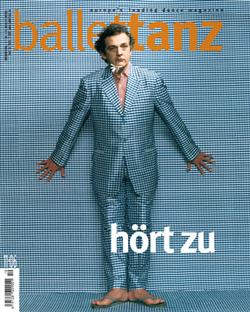
To complain about the communication problem between the audience and contemporary dance is to state a platitude that is by now merely rhetorical. For Portuguese choreographer João Fiadeiro, for one, this is no matter for concern. “In a contemporary performance we are not going to confirm expectations but be confronted with something. We are in a territory of...
Wenn ein Tänzer respektive Performer die Bühne betritt, dann trennt sich die Kraft: zwischen dem Darsteller, dessen Name im Programmheft zu lesen ist, und seiner Figur oder Gestalt. Ersterer repräsentiert den Werktätigen, zweiterer sind Werkstücke, die er dem Publikum zur Verfügung stellt. Insofern bieten Tänzer ihrem Publikum einen Service an. Sie sind...
Since founding his company in 1984, Stephen Petronio has continually forged collaborations with intriguing artists from other disciplines including composers, visual artists, and fashion designers. This year, the wonderful singer and songwriter Rufus Wainwright composed a suite of songs for Petronio’s “Bloom,” which premiered at the Joyce Theater. Also on the...