Dancing Labiche

James Kudelka, artistic director of the National Ballet of Canada, is the first choreographer to attempt a full-length adaptation of Eugène Labiche and Marc Michel‘s wildly successful 1851 French farce, “Un chapeau de paille d‘Italie.” Whether Kudelka was wise in the attempt remains an open question.
Comedy at the best of times is not easy to accomplish in ballet. Farce is a comedic genre with a specialized internal logic. Although its physical antics lend themselves to dance, the word play and plot convolutions of farce are harder to crack.
Kudelka and his dramaturg, Timothy Luginbuhl, obviously understood this in devising a scenario that tries to simplify and focus the action. They also advance the period to 1890, allowing designer Santo Loquasto to evoke the flamboyant dress of the mid-Belle Epoque and cleverly incorporate the Eiffel Tower. However, trying to sort out who is doing what-and why they are doing it-remains a challenge for the audience, even after reading the synopsis in the program.
“An Italian Straw Hat” concerns the predicament of a wealthy Parisian, Ferdinand. On the morning of his wedding to the virtuous Hélène, Ferdinand‘s horse eats the elegant straw hat of ...
Weiterlesen mit dem digitalen Monats-Abo
Sie sind bereits Abonnent von tanz? Loggen Sie sich hier ein

- Alle tanz-Artikel online lesen
- Zugang zum ePaper
- Lesegenuss auf allen Endgeräten
- Zugang zum Onlinearchiv von tanz
Sie können alle Vorteile des Abos
sofort nutzen
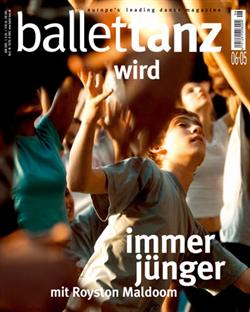
Am liebsten, sagt Royston Maldoom, sind ihm die kleinen Projekte. Die Arbeit mitten im Bruderkrieg in Bosnien, am Ende der Apartheid in Südafrika, im Dauerkonflikt zwischen Katholiken und Protestanten in Nordirland, die Arbeit mit Gefängnis-Insassen, Straßenkindern und, immer wieder, Jugendlichen aus allen Teilen der Welt. Maldoom begründete in den frühen 1980er...
«Wikis» und «(We)Blogs» heißen neue Formen des sprachlichen Umgangs: Auch dieser Text ist so ein kleines Wiki, weil ihn zwei Redakteure schreiben, sich die Meinung also teilen. Große Wikis, Manifeste etwa zur Zukunft der zeitgenössischen Choreografenausbildung, entstehen auf virtuellen Kongressen. Man sitzt am Computer und gestaltet aus Fragen und Kritik die...
Raisa Struchkova, an outstanding Stalinist-era prima ballerina, died on March 3, at the age of 79. She belonged to that glorious cohort of Soviet ballerinas of the 1940‘s and ‘50s who officially established the Russian Empire style on the stage of the Bolshoi Theatre, while in reality enriching it with humanity and a complexity of emotions.
Struchkova graduated from...