"Opera belongs to the whole world”
In its 200th anniversary year, the Teatro Real in Madrid took on the additional role of conference host for the world premiere of the “World Opera Forum”. Over 200 participants from the opera associations Opera Europa, Opera America and Opera Latinoamerica met in Madrid from the 12th to the 15th April.
Even the format was a premiere, with open-floor discussions taking precedence over lectures and panel talks. The event looked ahead to the future, not only of opera but also of communication culture.
Serving as a congress centre during the day and showing performances in the evenings, the Teatro Real rose to the logistical challenge admirably. It even mounted a Benjamin Britten premiere during its three days of dual functioning. Two hours before the curtain went up on Britten’s opera “La Gloriana”, artistic director Ignacio Garcia-Belenguer opened the congress in the main hall. In his rousing welcome speech, he declared that opera has long since become more than a European art form; now “it belongs to the whole world”!
Over three days of intense discussions, 300 participants from Europe, America, Asia and the Middle East offered refreshing insights into a centuries-old genre that is being embraced by more and more parts of the world – not only on the opera stage but also in film and, increasingly, live streams to TV screens at home. Will the weight of history crush the genre of opera in the future? Can new works revitalise the opera, as they have theatre and cinema? How can opera (re-)gain significance for a young audience in the 21st century? These were the main issues discussed by the opera associations Opera America, Opera Europa and Opera Latinoamerica at the first “World Opera Forum” in Madrid’s Teatro Real.
True to its name, the forum was arranged to allow as many participants as possible to voice their opinions and ideas. For this reason, the number of participants had to be limited, and the course of the conference strictly choreographed. Two points were put forward for discussion each day. To open, the big, but very general, question of “will opera ultimately be destroyed by the very richness and importance of its historical legacy?” was debated. In Europe, 2018 was officially declared Cultural Inheritance Year. Ways of preserving as well as revitalising that inheritance are eagerly being sought.
The second round of discussions focussed on contemporary works. How can the modern repertoire’s appeal be raised – like in film and theatre, where audiences are keen to experience new works and explore new topics? Perhaps modern constructions, like the Oslo opera house, are better suited to getting the public interested in opera – old and new – than traditional theatres, which might come across as monuments or even foreboding fortresses.
That was just one idea on the question of how to get a broader public interested in the opera. In the U.S., an important factor currently is arranging the repertoire to reflect social trends, such as diversity. Good intentions are not enough – “you just have to do it”, as Graham Vick, artistic director of the U.K.’s Birmingham opera house, called out enthusiastically to all present. The exchange of ideas in Madrid really was considerably more direct and diverse than the usual lecture-and-panel-talk arrangement. Talking face-to-face instead of posting comments on the internet – let’s hope that’s the future!
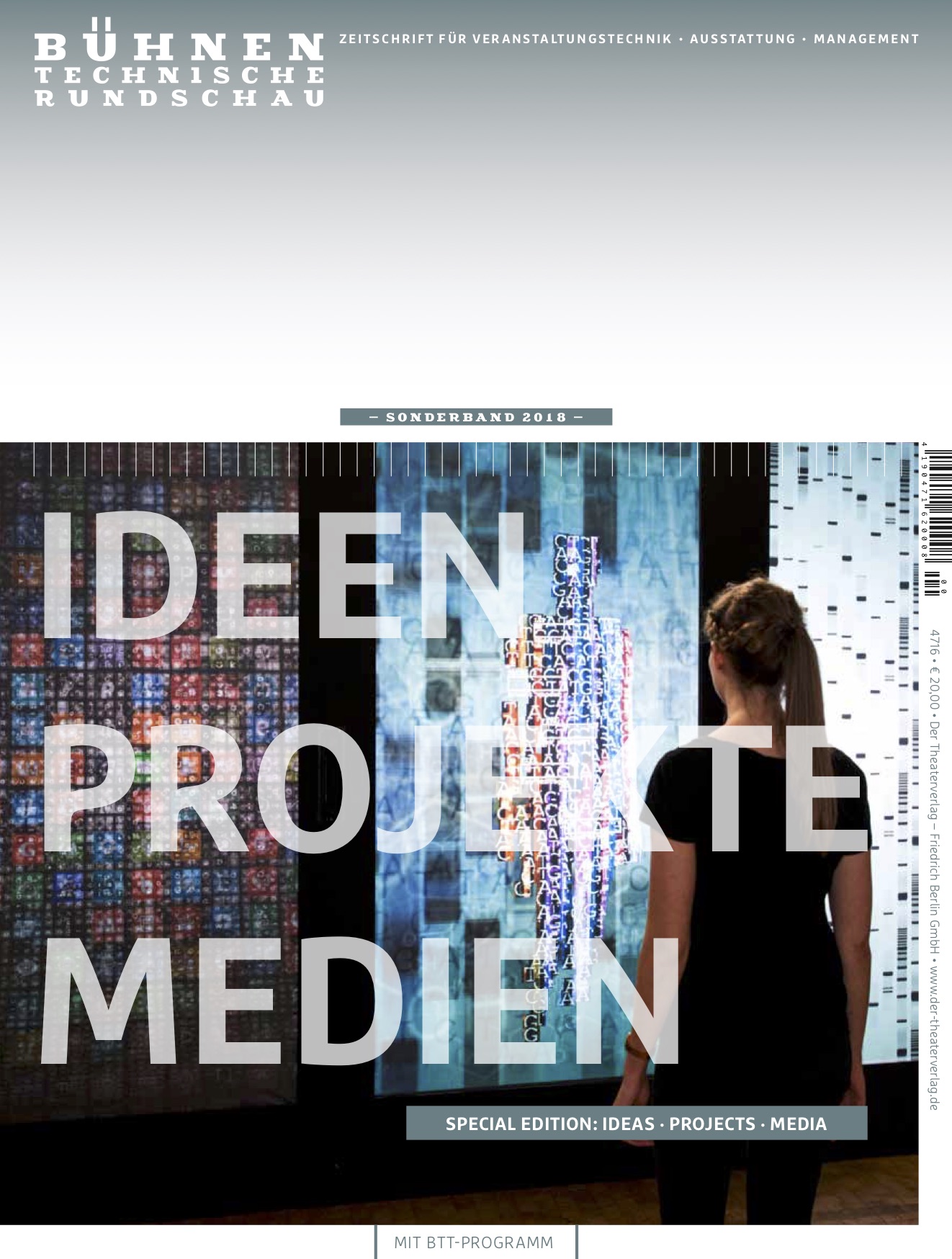
BTR Sonderband 2018
Rubrik: English Texts, Seite 228
von Karin Winkelsesser
The Atelier des Lumières is a digital-age space for experiencing the fine arts, located in a former iron foundry in the centre of Paris. Run by Culturespaces, it is currently bringing the works of Klimt and Hundertwasser digitally to life in 3D animations. As an alternative to the reverent inspection of brilliant brushstrokes in lofty temples to art, visitors here are invited to immerse...
Mit einem 8500 Quadratmeter großen Neubau wollen die Niedersächsischen Staatstheater in Hannover ihre Werkstätten an einem Standort zusammenführen. Bei dem Vorhaben ist das Theater nicht nur selbst Bauherr – und nicht das Land Niedersachsen –, sondern auch, dass es sich dabei um ein Pilotprojekt in Sachen „digitales Bauen“ handelt. Die Staatstheater sind die erste Einrichtung des Landes...
Bilder im Großformat sind für unterschiedliche Zwecke und Anlässe gefragt: für Außenwerbung, Inneneinrichtungen, auf Messen, Events und Modeschauen sowie für Film und Fernsehen, Theater und Oper. Seit 30 Jahren ist Big Image Systems erfahren im digitalen Großdruck – der Übergang von der Airbrush- zur Infinitus-Technik war entscheidend. Zudem haben sich Drucktechnik und -formate,...