To every age its art, to every art its freedom

One hundred years after the collapse of the Habsburg Monarchy, Vienna has launched a year of celebrations under the motto “beauty and the abyss” in honour of modernism. Four of its chief protagonists – Gustav Klimt, Egon Schiele, Otto Wagner and Koloman Moser – were active in turn-of-the-century Vienna and left a lasting imprint on the city. To coincide with the centenary, Vienna’s “world museum” was also reopened, showing collections once belonging to the now defunct monarchy.
It is a hundred years ago that the Belle Epoque and art nouveau were finally laid to rest among the ashes of the First World War. The end of the war in 1918 also sealed the fate of the multinational Austro-Hungarian Empire, consigning the Habsburg Monarchy to history. Today, visitors to Belvedere Castle, which Prince Eugene of Savoy, military commander and victor over the Turks, had built as his summer residence in 1715, can admire Gustav Klimt’s painting “The Kiss” and Egon Schiele’s stark self-portraits as well as décor designs by Koloman Moser, the founder of the Vienna Workshop (Wiener Werkstätte) and brilliant collaborator with architect Otto Wagner. All four of these artists died in 1918.
The centenary of that fateful year is being duly commemorated in Vienna with a year of events entitled “Vienna between beauty and the abyss”. The centenary exhibitions, concerts and special tours bring the era, to which we seem to be constantly and inevitably drawn, to vivid life. Vienna around 1900 was simmering like a pressure cooker seeking a vent. Eventually the energy burst out, launching the avant-garde. The arrival of people from all walks of life and all parts of the huge empire, Judaism, the suffragette movement, art nouveau and expressionism all went to make up the special Viennese blend of modernism for which the city is still famous today. And it continues to dominate the city’s style: in crockery, furniture, interiors, antiques, luxury goods and souvenirs, filling the shelves of museum shops and inner-city kiosks. Groups of Chinese tourists explore the city decked out in silk scarves printed with Klimtian gold-mosaic motifs.
A new concept for the World Museum
But Vienna would not be Vienna without its imperial heritage, so a visit to Heroes’ Square (Heldenplatz) is a must. Here, the World Museum reopened last autumn, after 13 years’ building work, with a new exhibition concept. The premises of the New Castle, a 1900-built extension of the old castle, had previously housed the Ethnological Museum (since 1928). Now, post modernism, the museum reflects critically on its history, whose roots lie in the colonial era. Although Austro-Hungary never had any colonies itself, Franz Ferdinand – the Crown Prince whose assassination in 1914 triggered the First World War – was voracious in his pursuit of exotic cultural treasures. Like his two fellow Archdukes, Maximilian of Mexico and Crown Prince Rudolf, he travelled the world in the late 19th century collecting cultural treasures from “foreign peoples” – a 400 year-old Habsburg tradition – intending to supplement and research the court collections, and no doubt to increase the family’s glory. The collection grew so large that most of the objects remain in storage – a mere 1.5 percent of it is on display. But even these make up 3000 exhibits filling 14 halls.
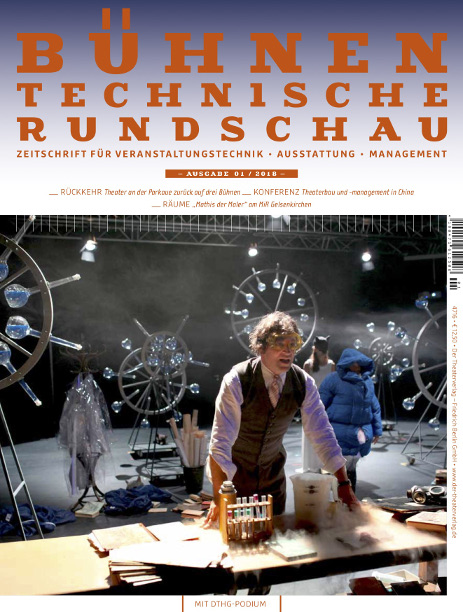
BTR Ausgabe 1 2018
Rubrik: English texts, Seite 103
von Irmgard Berner
„Braunschweig liegt am Meer“ lautet das Motto für die erste Spielzeit der Generalintendantin Dagmar Schlingmann am Staatstheater Braunschweig. Es stehe für die Freiheit, theatralische Behauptungen aufzustellen und das Publikum mit auf Entdeckungsreise zu nehmen. Die Eröffnungspremiere im Kleinen Haus löst dieses Versprechen ein. In der Inszenierung „Moby Dick“ werden die Zuschauer mit auf...
Weit sichtbar auf einer Anhöhe mit Blick auf den Eiffelturm liegt das Palais de Chaillot in Paris, ein Gebäudekomplex von 1937. Das Areal beherbergt heute unter anderem das Théâtre National du Chaillot, das einzige Nationaltheater Frankreichs für Tanz. Einer seiner unteridisch gelegenen Säle, die Salle Firmin Gémier, wurde 2015 abgerissen und durch einen Neubau ersetzt. Bei den...
Bestellung von Einzelheften, soweit nicht vergriffen, zum Preis von 12,50 Euro (zuzüglich Porto) an:
Der Theaterverlag — Friedrich Berlin GmbH, Nestorstraße 8–9, 10709 Berlin, E-Mail: redaktion@btr-friedrich.de
1 Bau und Betrieb
Athen Mut machen und nach vorne schauen – Das Stavros Niarchos Foundation Cultural Center in Athen SB/2017
Athen Opernhaus Athen: Innovative Lösungen –...