Revisiting past successes

The past season at the Komische Oper in Berlin was dedicated to celebrating the theatre’s 70th anniversary. As well as many premieres, showcasing the theatre’s contemporary edge, artistic director Barrie Kosky chose the productions ‘Anatevka’ and ‘Blaubart’ from the past repertoire because they played such an important role in the history of the theatre. Kosky directed ‘Anatevka’ himself and invited Stefan Herheim to re-stage ‘Blaubart’.
“This is classic music theatre, and we didn’t need or want any high-tech designs with projection screens or moving images,” explained technical director Daniel Kaiser at our meeting shortly before the end of the season. The two historical productions are intended primarily as tributes to the man who re-established the Komische Oper after the Second World War: Walter Felsenstein (1901-1975). His productions of ‘Anatevka’ and ‘Blaubart’ were legendary successes: ‘Anatevka’ was premiered on 23 January 1971, ran for 500 performances and was seen by over half a million people before being dropped in summer 1988. Similarly, ‘Blaubart’ was performed 369 times between 1963 and 1993.
‘Anatevka’ – a musical makes history
The new production by Barrie Kosky echoed Felsenstein’s success and was sold out for the entire season. Rufus Didwiszus was engaged to create the stage set. For ‘Anatevka’ he designed a wall of stacked cupboards, which come to life in various ways throughout the performance. Artistic director Kosky came up with the basic idea of the cupboard, which Didwiszus took as the starting point for the full stage set, portraying the shtetl, or village community. The set designer explained: “The first cupboard was actually taken from a childhood memory of Barrie Kosky’s. Over time, that developed into our starting scene: a modern boy, a violin and a cupboard. And then, all of a sudden, his great-grandfather comes out of the cupboard, followed by the entire village, and the one cupboard becomes a whole pile of stacked cupboards from different decades and centuries; a pile of history and memories crossing many generations. We never considered having an actual objective village on the stage for this approach to telling the story.”
While the wall of cupboards gradually reveals ever more life within it, the actual frame for the musical is an empty stage, blending the different worlds.
Stage set construction
In terms of stage design, the cupboard construction is a classic. It consists of four subcomponents and around 30 cupboards, or cupboard-parts, which are moved on the stage’s 13 m-diameter turntable. Fully assembled, the construction is 6.5 m high and 10 m wide. The various folding and collapsing mechanisms are integrated in the door systems to enable the singers to open and climb through them with ease.
The beechwood backdrop is a print 14 m wide and 10 m high; the entire cabinet is 10 m deep. The (paper) snow that falls throughout the second act was moved by hand using three standard snow sacks and manual counter hoists.
‘Blaubart’
Over 50 years since its acclaimed premiere, ‘Blaubart’ (Barbe-Bleu/Bluebeard) was revived by Stefan Herheim, a director known for his opulent productions. With stage designer Christof Hetzer and musical director Stefan Soltész, Herheim created a new version of Walter Felsenstein’s production, combining historical and contemporary elements. The libretto of the opéra bouffe is loosely based on an ancient French fairytale, which is given even more contemporary twists here.
The wagon stage
The stage set harks back to the pageant wagon of ancient travelling theatres. While taking inspiration from Felsenstein’s production, Christof Hetzer also added new elements. As he explained: “We quoted some iconic moments from the Felsenstein production, such as Bluebeard’s costume and the costume of King Bobèche; we also incorporated these references into the text, but always as an ironic quote. The setting is basically a mishap: the pageant wagon, which is drawn by a rather worse-for-wear Cupid and steered by Death across the opera stages of the world, has an accident when Cupid collapses. To revive him, Death gets the barrel organ going. The very naïve portrayal of a pastoral appears – the blueprint for opera librettos, so to speak. But then something goes wrong, Cupid jumps on the stage and the puppet theatre comes to life. It gets out of control and in a chain reaction, the first act of ‘Blaubart’ is sparked from the pastoral.
Over the course of the spirited production, the pageant wagon comes to play an important role as a magic cabinet. The curtain emblazoned with the words ‘Varieté Vanitas’ is raised; the wagon divides into two parts, which move aside, and a stage is pushed forward from behind. A colourful semi-circle of village and forest scenery appears and a dispute over women begins. The wagon has four ‘good’ sides and when the stage turns, Bluebeard’s world appears from the rear – a castle where Bluebeard’s knights are having a loudly drunken reverie. Two parallel worlds – that of King Bobèche and that of Bluebeard – alternate by rotation and push the plot ahead.
The stage set works with a “classic stage design and grammar, as practised in theatre for the last 250 years,” says technical director Daniel Kaiser. Contemporary additions that interrupt the classic interplay create ironic distance.
The finale is a courtly celebration that Bluebeard wants to disrupt. But the murdered wives and the men injured by Bluebeard appear on the scene disguised as gypsies and expose him. The stage is empty again, like at the beginning; the scenario comes full circle. The pageant wagon re-enters, Cupid and Death continue arguing, and the lovers are united – and disappear inside before the curtain falls. The game of love and death can start anew.
Stage set construction
In its closed form, the wagon measures 5 m x 3 m x 2.5 m and is moved manually by the stage technicians. It can be split in two in the middle, also by hand. The scenery is painted and can be pushed forward in different formations to vary the imagery. The printed handbills on the Humboldt Forum are drawn up on steel cables, and installed and removed, using classic stage technology.
Look ahead
The objective was to show two popular productions from the opera’s past to mark its 70th anniversary. “We are telling a classic music-theatre story by classic stage-technological means,” said Kaiser. In this case, then, relying on the ancient was an intentional, not stopgap, solution. But much is improvised at the theatre out of necessity – because the technical facilities, like the entire house, have seen better days. Preparations are in fact underway for a full-scale renovation, due to start in 2022.
An informative digital exhibition on the history of the theatre, dating back to 1774, can be seen on the opera’s website: www.komische-oper-berlin.de
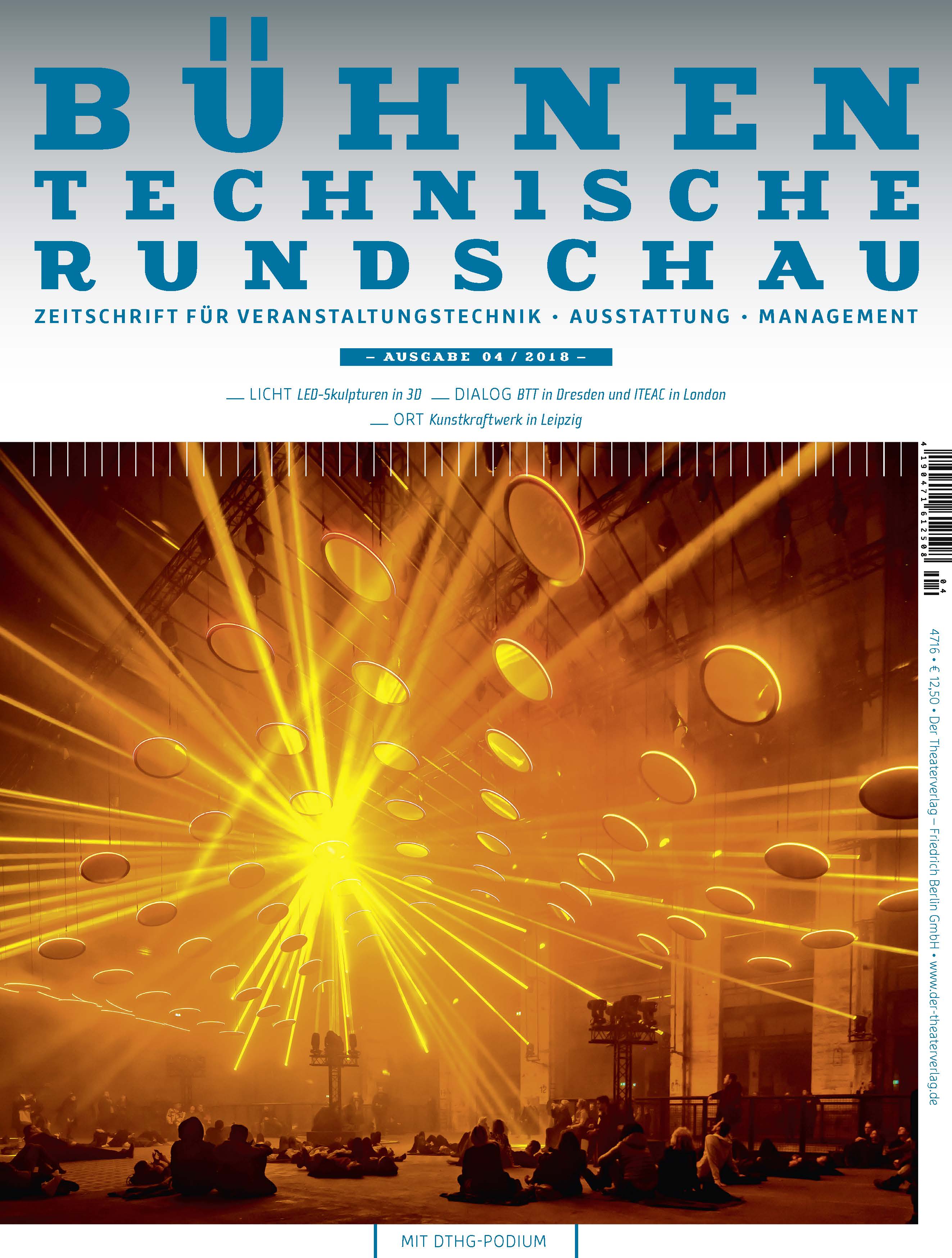
BTR Ausgabe 4 2018
Rubrik: English texts, Seite 239
von Karin Winkelssesser
Im Sommersemester 2016 wurden an der Hochschule Coburg aus Architektur und Bauingenieurwesen 14 Entwürfe zum Thema „Ausweichspielstätte für das Landestheater“ erarbeitet. Das Raumkonzept von Isabell Stengel und Anders Macht, ein Globe-Theater, wurde noch Ende 2016 als zu teuer von der Stadt abgelehnt. Nun soll der Rundbau doch realisiert werden.
Seit Jahren ist das Landestheater Coburg,...
Dan Flavin und Marcia Hafif haben sich in den 70er-Jahren neuen Medien zugewandt. Sie bewegten sich in der alternativen Kunstszene von New York City, kannten sich persönlich und hatten einen starken persönlichen Bezug zu München. Erstmals wird nahezu das ganze filmische Werk Hafifs im dortigen Kunstbau gezeigt, der im Licht der Leuchtstoffröhren von Flavins Spätwerk strahlt. In den...
Als die Arena Stage in Washington D. C. 1961 eingeweiht wurde, war es erst das zweite professionelle Theater in dieser Bauform in den USA oder vielleicht auch der Welt. Woher stammt diese besondere Theaterform, bei der nach allen Seiten gespielt wird? Spuren führen in die Antike, aber auch in Max Reinhardts Kammerspiele in Berlin. Die Arena Stage besteht noch heute, und der Autor,...