Inventiveness and constructiveness
The recent stage ꟾ set ꟾ scenery showed all facets of stageworld-building and provided ample opportunity to discuss them in numerous talks and roundtable discussions. To round off this year’s successful conference, the most outstanding “stageworld-builders”, whose productions testified to the almost boundless range of constructive solutions for artistic ideas, were honoured with Weltenbauer awards.
This spring, again, theatre- and festival-goers could witness a wealth of inventive and imaginative interaction between the various players in theatre.
The ten “most remarkable” theatre productions in the German language invited to take part in the 54th Theatertreffen drama meeting once again showed a creative and – following an initial phase of euphoria – measured, but skilful, use of new media. From large municipal theatres to small fringe drama-studios, the financial and spatial conditions vary greatly, and the productions featured were correspondingly diverse. Where subject matter is concerned, however, there is the major common denominator of dismay at the current state of the world. At the Radikal jung festival in Munich, especially, the young ensembles vigorously fought the sense of crisis in emboldening shows of spirit.
The ITI’s festival Theater der Welt, organized by Thalia Theater and Kampnagel, took visitors out of the theatre and to unfamiliar places around the harbour. Showing the public the international world of theatre in this way required a lot of application bureaucracy and artistic flexibility. In Hanover, the KunstFestSpiele Herrenhausen festival converted a Volkswagen van production plant in Hanover-Stöcken into a concert venue. Factory workers and other guests at the concert got to see the plant in a completely different light – or for the very first time – making it a doubly special moment.
Friedrich Kiesler was an early visionary of innovative theatre forms. This year’s Berliner Festspiele festival dedicated a major exhibition to him. The amorphous theatre models on show here can only now be built – thanks to the state of technology – 100 years later. Conversely, theatres were built years ago in innovative forms that did not catch on and are now somewhat overlooked. That is why a group of directors of round theatres has formed a network to spotlight their striking 360° houses.
As always, in this issue we report on technologies and constructions that make all aspects of life in and around the theatre easier and provide inspiration for new ideas. Researching room climate, the pros and cons of using CNC milling machines, renovating the audio technology for musicals – these are the topics we look at, as well as presenting new products.
The enclosed issue of Podium contains all the latest news from the association. A special focus is the regional meetings that drew large attendances and have proven to be a firm fixture for professional development within the German stage technicians’ association.
We hope to contribute to that with this issue of BTR and wish you an inspiring read!
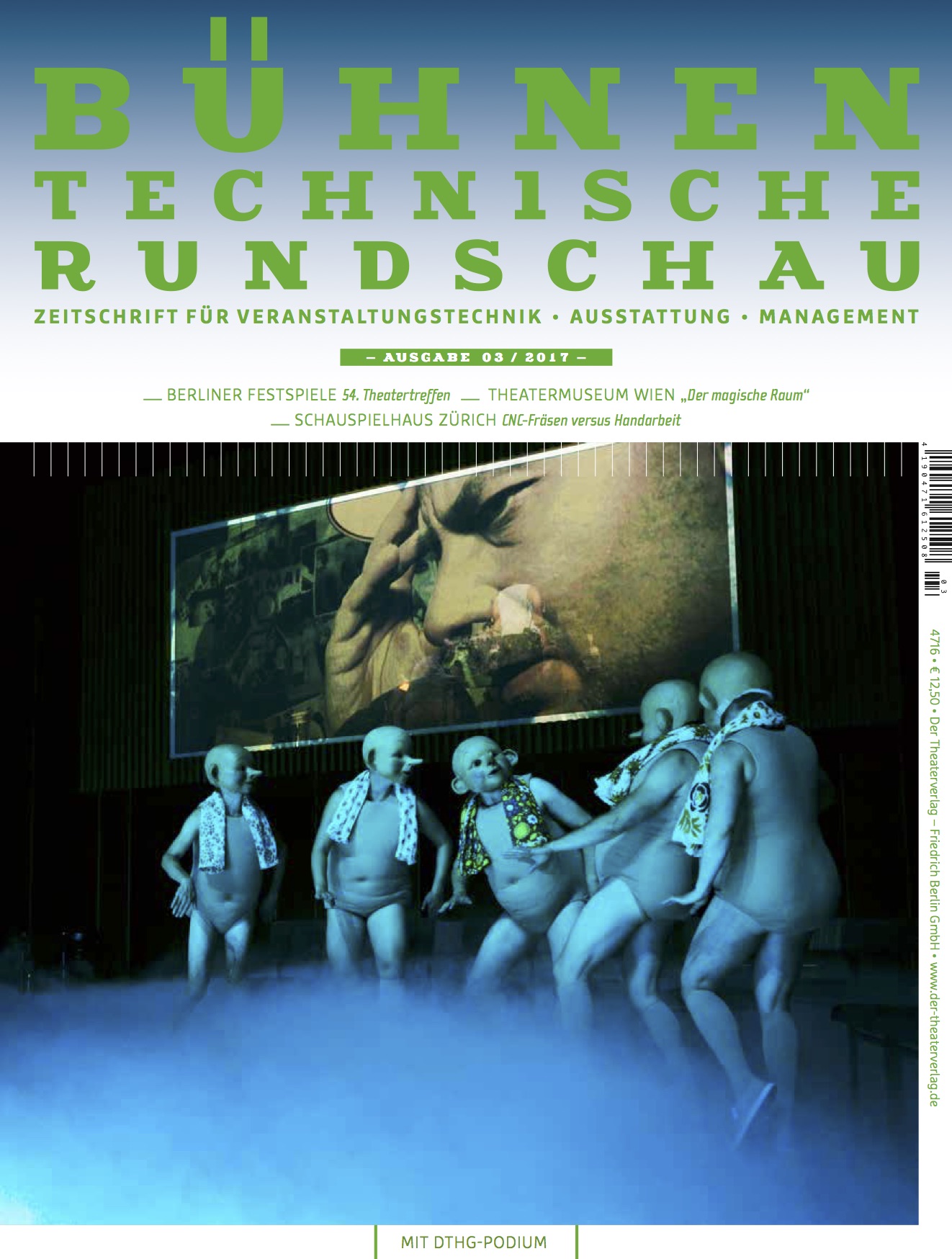
BTR Ausgabe 3 2017
Rubrik: English texts, Seite 99
von Redaktion
Ein goldener Raum, komplett ausgefüllt von einem riesigen Kissen: Unser Autor hat die Entwicklung dieses „unförmigen“ Bühnenbilds dokumentiert, vom Computer- und Tonmodell bis zur Herstellung. Der Vergleich der zwei Methoden – maschinelle Fertigung und Handarbeit – zeigt, dass jede mit erheblichem Aufwand verbunden war. Alle Vor- und Nachteile ergaben sich erst im Prozess der Planung....
The documenta is the world’s leading exhibition of contemporary art, held every five years in Kassel, Germany. This year, for the first time since its inception in 1955, it gained an additional location – one part of the exhibition was shown in Athens from 8 April to 16 July, while the second part opened on 10 June in Kassel, for the traditional 100 days. Reflecting the fluid boundaries...
Im Rahmen eines Forschungsprojekts an der Technischen Hochschule Köln werden energetische Kennwerte und Daten zum Raumkomfort in Theater- und Opernhäusern erfasst. Das Projekt besteht aus einer Querschnittserhebung in 10 bis 15 Theaterspielstätten innerhalb Deutschlands und aus einem Intensivmonitoring (BTR 5/2016). Die Querschnittserhebung läuft bereits seit Herbst 2016 in acht Häusern,...