Going under (stage) ground

The Greek director and stage designer Dimitris Papaioannou gained international renown with his production of the opening and closing ceremonies for the 2004 Olympic Games in Athens. Since then, he has become a firm fixture on the international theatre scene. With his fragmentary worlds of bodies and materials, he creates compelling images that really get under the viewer’s skin. His latest production “The Great Tamer” showed to great acclaim at the Festival of Avignon.
Do you remember the name of the man behind the opening and closing ceremonies at the Athens Olympic Games in 2004? Dimitris Papaioannou! If you watched them on TV, you won’t have forgotten the video-art frescoes and choreographies that Papaioannou used to translate the world of Greek gods and myths into a contemporary visual language. Thanks to the prestige this earned him in his home country, he is now one of the few artists in Athens to be able to bring major new productions to the stage. This summer, his production of “The Great Tamer” thrilled audiences at the Avignon Festival.
Following a series of large-scale productions, he now concentrated his efforts on achieving maximum effect by minimal means – partly in view of the difficult economic situation in his home country.
Underground
The story and scenography of “The Great Tamer” is based on a real-life tragedy that arose from the current troubles in Greek society. A teenage boy was stalked, pursued and chased by a group of other boys. Eventually his lifeless body was found under the ground. He had burrowed himself in – in a sense, buried himself – to escape the torment. The underground symbolism is introduced to the piece by an astronaut, who creates the perfect illusion of zero gravity. In this way, he transforms the stage into the imaginary surface of an extraterrestrial rock. Instead of reaching for the stars in the skies, he cuts into the ground and digs stones out. Again and again, actors fall into the ground and have to be “rescued”. Or they emerge from it, in a seemingly endless chain of underground dwellers. This is where Narcissus and Demeter dwell, and find water or volcanic ash under the broken-up rocks. Papaioannou built a slope to cover the entire plateau, over a metre high at the back edge of the stage. As we gradually realize during the course of the play, the surface is made of a few pliable rubber panels and many more rigid wooden panels. The former, painted white, can be turned round to look like two beach towels on the dark grey slope. The advantage of the wooden panels is their loud cracking when they are broken underfoot. That is intentional, of course, as under the stage there is another, invisible choreography taking place.
In the beginning was the sketch
In conversation with BTR, Papaiannou explained that he started off with some sketches, drawings and images, which became concretized over time. He and the actors conducted improvisation and research to keep generating new images from their bodies, the set and materials. Indeed, Papaiannou only ever makes notes in the form of sketches. He does not decide on a name or a title until shortly before completion. Perhaps the richness and power of his imagery lies in precisely this lack of words, BTR asked. Papaiannou responded: “I see myself as a writer and a painter, with the stage as my medium. I paint, draw and photograph. What I show people is only part of my creativity. I need visual composition to survive.”
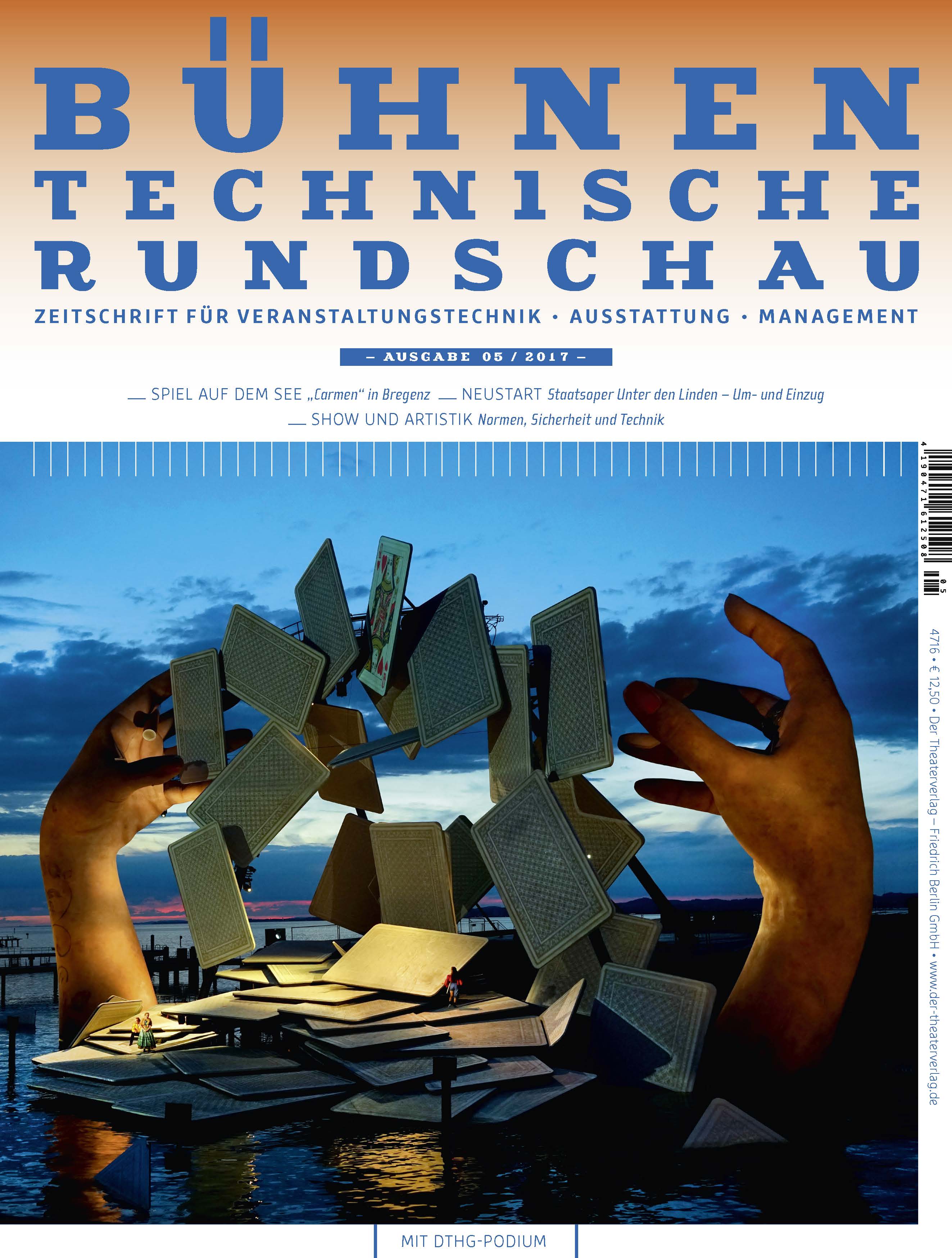
BTR Ausgabe 5 2017
Rubrik: English texts, Seite 134
von Thomas Hahn
„Die Meistersinger von Nürnberg“ is Richard Wagner’s thorniest work. For the new production at Bayreuth, the festival directors invited Barrie Kosky, artistic director of Berlin’s Komische Oper, to the Green Hill. It was an inspired move – the Australian director with a knack for light entertainment and a reputation for cheeky, musical-loving theatre, cleverly updated the piece....
Eine steinerne Bogenbrücke wurde zum Walfänger-Schiff, der Schweizer Wohlensee zum Ozean – vier Wochen lang, an vier Abenden in der Woche spielte die Berner Gruppe VOR ORT – bei jedem Wetter. „Moby Dick“ auf dem See lieferte keine fertigen Bilder, sondern viel Raum für Assoziationen. Mit der Audioproduktion, einem wichtigen Teil des Stücks, konnte das Publikum akustisch in das dramatische...
„Die Meistersinger von Nürnberg“ war die diesjährige Neuproduktion der Bayreuther Festspiele. Raffiniert inszenierte Barrie Kosky die Oper über einen Sängerwettbewerb – unter der musikalischen Leitung von Philippe Jordan – historisch vielschichtig. Er verquickt Wagners Zeit mit dem Mittelalter und den Nürnberger Prozessen. Die Autorin stellt die Zusammenarbeit der Bühnenbildnerin Rebecca...