Flexibility for Dance: The new Chaillot Theatre

Visible for miles around, set upon an elevation where the Trocadéro once stood, is the Palais de Chaillot in Paris. The 1937-built complex is home to the Théâtre National du Chaillot, among other things. Recent construction work saw the demolition of one of its halls, the Salle Firmin Gémier, to make way for redevelopment. The project called to mind some compelling Parisian history.
It isn’t often that a new theatre hall is built in one of the most architecturally and historically remarkable quarters of the French capital, in the centre of Paris.
In fact, it’s a unique event, at least for this century. Yet a few years ago, a construction ditch was opened up within Palais de Chaillot, with its spectacular view of the Champ de Mars and the Eiffel Tower through the foyer’s seemingly endless glass façade, when the Salle Firmin Gémier and the Esplanade above it were demolished. In their place, a completely new theatre hall was built at a cost of 21.5 million Euros, covered by a new esplanade, costing 6.6 million Euros. The result is a modern, multipurpose theatre seating 390, with a retractable platform: the new Salle Firmin Gémier, which opened its doors in September 2017. It is named after the director Gémier (1869-1933) who founded the Théâtre National Populaire in the Palais du Trocadéro in 1920. This marked the first step towards a “democratization” of the dramatic arts in France, a process which was later continued by Jean Vilar (1912-1971), the founder of the Avignon Festival. The large hall of the Théâtre National Populaire de Chaillot still bears Vilar’s name to this day.
The origins of the building date back to 1878, when Paris hosted its third World’s Fair. To accommodate it, a mighty semi-circular structure was erected and named “Palais du Trocadéro”. Then in 1935, when the city was set to hold a specialized world exhibition, the entire building apart from the wings was torn down and a new structure built on the foundations. The new “Palais de Chaillot” opened in 1937, despite major difficulties. Its theatre hall was wider than it was deep and designed for multipurpose use. For some months in 1948, it became the seat of the U.N.; the Universal Declaration of Human Rights was signed in its main hall that year. But to show performances, the architecture needed changing. In the 1970s, then artistic director and later Minister of Culture Jack Lang had the proscenium stage turned into a grand hall with a frontal stage, designed by renowned theatre architects Fabre and Perrottet.
In 2016, under the direction of Didier Deschamps, the theatre was repurposed as the Théâtre National de la Danse, France’s only national theatre dedicated to dance. However, its halls had been designed with spoken-word theatre, not dance, in mind. From the rear of the main hall (Salle Jean Vilar), seating 1217, one has neither a full view nor the feeling of being taken on a journey by the dancers. And in dance, especially, it is important to create a sense of closeness to the audience. From the upper seats, one virtually seems to be watching a video, and on a mini-screen to boot.
The medium-sized hall, seating some 400, known as Salle Firmin Gémier, was even less suited to dance performances. Opened in 1967, it had been installed in a rather rough-and-ready fashion in the former smoking lounge of the Palais de Chaillot. Anyone sitting too far to the side was bound to miss some of the performance. And the dancers’ feet could not always be seen even from the front – a major handicap in contemporary dance, which depends on its intimate, intense link with the ground. The theatre’s urgently needed conversion began in June 2014 and took three years to complete.
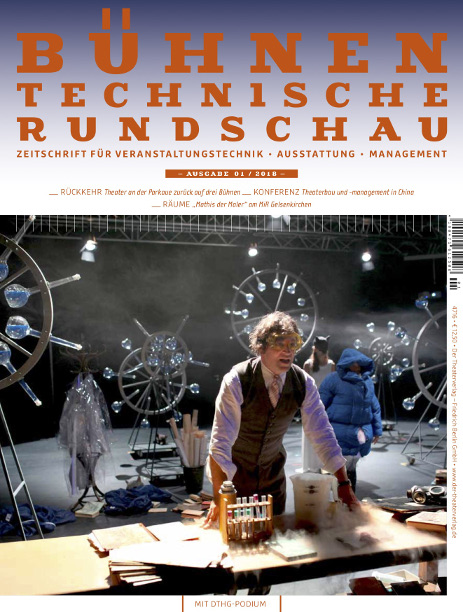
BTR Ausgabe 1 2018
Rubrik: English texts, Seite 102
von Thomas Hahn
In der ersten Ausgabe zum neuen Jahr steht das Duo von Technik und Handwerk im Vordergrund, dessen gutes Ineinandergreifen Voraussetzung für einen reibungslosen Betrieb, aber auch qualitätsvolle Bühnenkunst ist. Eingangs blicken wir anlässlich einer internationalen Konferenz zunächst wieder einmal nach Fernost, genauer nach China. Nach der Begeisterung über die zahllosen Neubauten mit...
Münster hat viele Studenten. Deshalb auch viele Copy-Shops – und viel Verpackungsmaterial, das entsorgt werden muss, dazu gehören auch Papprollen. „Was für eine Verschwendung“, dachte sich Victoria Davalos, die gerade ihre Masterarbeit schreibt – und plante, aus diesen Papprollen mit dem Einsatz digitaler Technologien nun Möbel und Objekte herzustellen.
Victoria Davalos studiert an...
Am 16. und 17. November 2017 fand auf dem Gelände der Expo 2010 zum zweiten Mal eine internationale Konferenz zum Thema Theaterbau und -management statt. In China werden nach wie vor erstaunlich viele neue Theater und vor allem Kulturzentren nach westlichem Vorbild und oft auch mit Unterstützung von westlichem Know-how errichtet. Wie aber sollen diese vielen Häuser bespielt und verwaltet...