In the hands of fortune

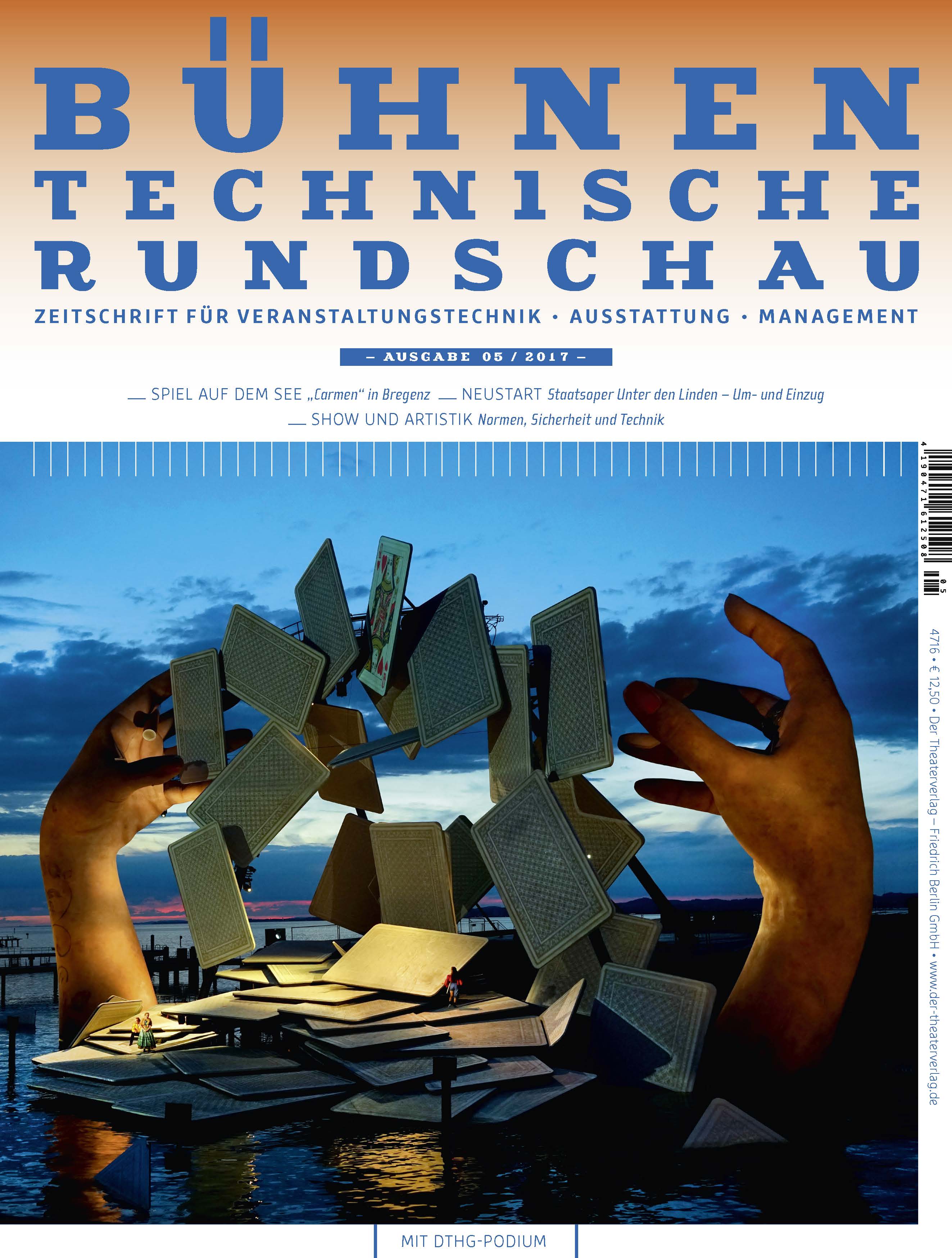
This year saw the 72nd edition of the Bregenz Festival. Once again, the lake stage proved a magnet for the public. Here, a production of Georges Bizet’s “Carmen” was attended by almost 7000 festival guests each evening, delighting them not only with its music and song but also with its extraordinary setting and effective projections.
Two enormous hands framing giant playing cards that seem to twirl between them loomed over the shore of Lake Constance.
The idea for the stage design was taken from the 3rd act of the opera, when Carmen consults cards to find out about her future and tell her fortune. Again and again, they predict her death. Stage designer Es Devlin explained that she wanted to depict the anarchic act of throwing everything up in the air. Director Kasper Holten transposed the story to the 1930s and the time of the Spanish Civil War (with costumes by Anja Vang Kragh). He sees freedom as a curse. Just throw everything in the air? What happens after that?
Hand-crafted, not scanned
Just getting from the idea to a usable model of a hand and lower arm took a lot of time and effort – the hand was modelled using labour-intensive, artistic methods. Because you can’t just scan a human hand for its data, explains Susanna Boehm, head of stage design for the Bregenz Festival.
Building the new stage set (at a cost of 7.5 million Euros) took roughly seven months. It rests on 119 wooden stakes made of spruce, newly embedded up to 6 m deep in the lakebed around the permanent construction, the ‘concrete core’, which is anchored in Lake Constance and houses the technical facilities and cloakrooms.
The two hands are installed some 30 m apart. One of them is 21 m high, weighs roughly 24 tons, including the lower arm, and holds a glimmering, smoking cigarette (6.3 m long and 0.72 m in diameter). At the thumb, there is space for performers to stand.
Fortune-telling cards
The two lower arms and hands loom over 20 m high over the lake with the playing cards between them, brightly painted and covered in a delicate pattern that was either painted on using templates or stuck on with a printed net. The cards are solid wooden panels (7 x 4.3 m) and each one weighs approx. 2.5 tons.
At centre stage, there is the “Cards and Nucleus” turntable, with a diameter of 10 m, behind which there are three static cards housing five loudspeakers.
A visually stunning show
Despite its considerable height and breadth (24 x 43 m), the ensemble of the twirling cards, lying on the floor or hovering in the air, framed by two hands, appears compact and cohesive. And it still offers plenty of space for all the performers to use. Music-theatre on Lake Constance is always more than just opera. “Carmen” features a blend of music and dance, artistry and acrobatics, stretching across the large stage and into the water. Pyrotechnics and fireworks are also included in this summery open-air show. Even the lake plays a role: performers dance in the water, characters and chorus members appear in boats, and Carmen escapes arrest by diving in. And the final scene has a special Lake Constance twist, too, thought up by Kasper Holten: Instead of stabbing Carmen, José drowns her.
BTR Ausgabe 5 2017
Rubrik: English texts, Seite 112
von Iris Abel
Seit mehreren Semestern entsteht an der Beuth Hochschule eine Theaterkartografie der Stadt Berlin in bestimmten historischen Momenten, begleitet von einem Katalog, der rund 250 historische sowie noch existierende Spielstätten vorstellt. Damit soll die architektonische, szenische und technische Struktur verglichen und analysiert werden. Zudem erlaubt diese Systematik Rückschlüsse auf die...
Staatsoper Berlin 2010–2017
von Jürgen Flimm, Detlev Giese, Regula Lüscher (Hrsg.)
496 Seiten · 450 Abbildungen
22,5 × 28 cm · 2 Bände im Schuber
ISBN 978-3-86922-654-5
DOM publishers, Berlin 2017
EUR 58,00 / SFR 74,70
Bei Redaktionsschluss dieser BTR bereitete sich die Staatsoper Unter den Linden auf das große Ereignis vor, die Eröffnung des sanierten Hauses Unter den Linden am 3. Oktober...
Besonders eine Figur dominierte die Berichterstattung über die Neuinszenierung bei den Bayreuther Festspielen: ein gigantischer Judenkopf. Er kommt aus der Unterbühne und wird szenisch aufgeblasen – lautlos. Der Konstrukteur stellt die technische Realisierung der Erfindung vor, aber auch die Unterkonstruktion zum Transportieren des schweren Bühnenbilds, das nach realen Vorbildern wie der...