Simply Straw Mats

The name chosen for the work is taken from a section in Georg Büchner’s play “Woyzeck.” By choosing this particular literary quote, Be’er circumvents the main theme of the play: the story of an anti-hero, a victim of war and its warped morals. Yet, the textual source inevitably raises certain expectations, particularly since Rami Be’er has been known to touch on sensitive political issues and successfully infuse them in his dance, ever since “Reservist Diary” (1989), “Aide Memoire” (1994) and “Screensaver” (2002) earned him international acclaim.
Their stronger impact derives from his subtle weaving of content and form, producing richly layered work. “Upon Reaching The Sun,” however, belongs to a different body of work in which striking effects created by complex sets, lighting or multifunctional props play a major role in supporting the dance. These works generate scores of arresting visual images of great beauty without having a lasting or disturbing mental impact.
Rami Be’er himself is involved in designing all the elements and often claims that they are as important to him as the choreography, and that his attention is not focused on pure body movement. As a result, several of ...
Weiterlesen mit dem digitalen Monats-Abo
Sie sind bereits Abonnent von tanz? Loggen Sie sich hier ein

- Alle tanz-Artikel online lesen
- Zugang zum ePaper
- Lesegenuss auf allen Endgeräten
- Zugang zum Onlinearchiv von tanz
Sie können alle Vorteile des Abos
sofort nutzen
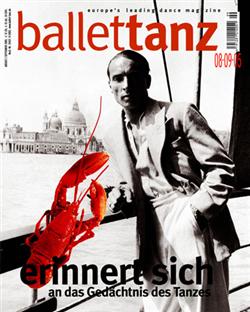
By early 2006, choreographer and Professor of Choreography at the University College of Dance in Stockholm, Efva Lilja, will have completed her artistic research project “The Memory of the Body.“ To Lilja, human memory is a re-construction that is constantly changing as a consequence of the dynamic mental processes that create accumulated memory. As she puts it,...
Der Kern der Tanzgeschichte, also der Tanz, ist abwesend. Sobald Tanz aus der Gegenwart fällt, ist er nur noch im Gedächtnis abrufbar, in der Körper-Erinnerung von Tänzern und Betrachtern, im Foto, in der Notation, im Video oder in der Kritik. Die Substanz des Tanzes, das Tanzen dagegen, ist nur präsent im Moment der Bewegung. Insofern ist der Gegenstand der...
Kaum war mein Artikel über Balanchines unvollendete «rjivfhs jvfhjd» in der Oktobernummer 2003 von ballet-tanz erschienen, steckte ich bereits wieder über beide Ohren im Schreiben eines Ballett-Szenarios für den Komponisten Philippe Fénelon und den Choreografen Daniel Larrieu nach Jorges Luis Borges weltberühmter Kurzgeschichte «Las ruinas circulares» – als sich...