Expensive

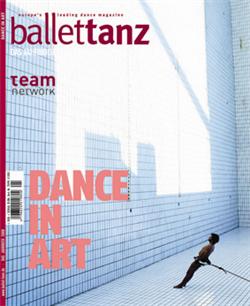
Why is there a double-digit million dollar difference between Damien Hirst’s shark in formaldehyde and the aquarium dances of Sasha Waltz or William Forsythe?
The answer is obvious? One is art and the other lasts 90 minutes. Stop! THAT difference is based on the inability to let go of our past as hunters and gatherers. And however reasonable it seems to treat dance and visual arts differently at the cash register, you might not do so quite as nonchalantly after examining the reasons that cemented your precept.
Like: the long-standing reputations of both art forms (built on criticism and popular prejudice), their respective aesthetic value (aka “beauty”), and, unavoidably, the money and time spent on either, two aspects much entwined.
“If I hear art …”
Assuming the above-mentioned are all three of them genuine artists, who have made a name for themselves in and beyond their domain, have garnered applause and met with suspicion, the striking gap in maximum turn-over remains. Why now is “a Hirst” so expensive? Because, probably after consulting an expert, some Jack Palance is willing to pay for exclusive ownership, and the art critics and other experts refrain from laughing. ...
Weiterlesen mit dem digitalen Monats-Abo
Sie sind bereits Abonnent von tanz? Loggen Sie sich hier ein

- Alle tanz-Artikel online lesen
- Zugang zum ePaper
- Lesegenuss auf allen Endgeräten
- Zugang zum Onlinearchiv von tanz
Sie können alle Vorteile des Abos
sofort nutzen
Jan Fabre, famous as you are, you do still very much like to take risks it seems.
It depends on what type of risk you are talking about: mental, physical or social risk. I often feel alone in the artistic landscape, because what I say, I do; what I make, I am. There are not many artists who are free to take risks, particularly in theatre. They are so steeped in...
“That spring day in 1994 on the Croatian island Krk was one of the most special days in my life,” says Marko Peljhan. On this island in the Kvarner Gulf, where there were practically no tourists in the first half of the 1990s, he – together with a team of co-workers with whom he was contemplating his third performance – set off for a location marked only by a...
Create, intervene within the cities despite constraints imposed by increasingly severe security rules … Artists’ “actions” in urban settings are becoming more and more difficult to put into place. Unless they foray into new terrain …
What is the artist’s place in the European urban space? Posing this question amounts to questioning the “street” artists as to...