Moving Ideas

Imagine a selection of drawings, scores, instructions or sketches created by choreographers during the process of making dances, e. g. Trisha Brown, Yvonne Rainer, Dominique Bagouet, Remy Charlip, Mary Wigman, William Forsythe and Elisabeth Streb.
How might we conceive of these as representations of choreographic thinking or as carriers of moving ideas? How would one describe a moving idea to someone who is not a dancer or choreographer? These questions compel us to ask: then what is a moving idea? How is it generated, where is it stored and how is it accessed? If this moving idea is at least partly produced through thinking choreographically, what is the relationship between movement, dance and thought? Within what contexts might we consider dancing to be thinking?
As a means of furthering this investigation I invite you, the reader, to perform the following three variations:
Variation One: Perform a movement by tracing the outline of a curve, using your fingers or hand (one finger thin or two thicker, etc.) starting at some point in the space in front of your sternum and ending at some point in the space above and behind your head.
Variation Two: Then imagine doing this movement, ...
Weiterlesen mit dem digitalen Monats-Abo
Sie sind bereits Abonnent von tanz? Loggen Sie sich hier ein

- Alle tanz-Artikel online lesen
- Zugang zum ePaper
- Lesegenuss auf allen Endgeräten
- Zugang zum Onlinearchiv von tanz
Sie können alle Vorteile des Abos
sofort nutzen
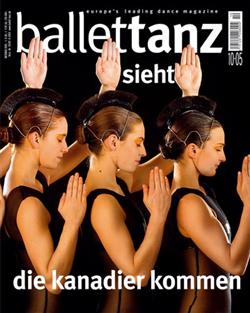
Over the last century dance has traveled from continent to continent, shifting its focal points of creativity and intensity. Historically, the fluctuating cartography situates long traditions in Berlin, Paris, and London. In the mid-1980s rejuvenation occurred in places like Brussels, Ljubljana, Barcelona, and Montéal. Guy Cools, the former dance programmer and...
Why do we dance why do we dance why do we dance – why do we make our very fragile, inadequate bodies dance, our beautiful, intelligent, post-human bodies dance? Post-human or is it trans-human? I mean: Our decoded bodies choreographed within a context or without a context, yielding to the scrutiny of the spectator’s gaze … For freedom?
In the days of the decoded...
For nearly 30 years, Marie Chouinard’s reputation has soared with dance and performance works that shock and amaze. Looking at photos of her choreography, if perhaps you have never seen the staged dance work, it’s possible to have the impression that you are looking at sculptures, at a kind of crystallization of the gestures.
“Crystallization” also happens to be...