Vanguard

You studied economics, how did you get into the creative business?
I found myself working as a choreographer, knowing little about dance or any other art form from which I could make the lateral leap into dance. So I started out using my body as my primary – and music as my secondary – material. In reality, I began to compose, which is something that had interested me since I was a child. As had organizing a group, which was something I’d undertake with those first childhood shows in the courtyard of our apartment block.
A little later, we made an entire neighbourhood out of cardboard-box houses; it was like a huge installation. Looking at old photographs, I realized that every single game I played as a child was staged as a performance.
Why dance rather than any other art form?
My relationship to my body. I was not interested in words, but movement was always of fundamental importance to me; which is how I ended up choreographing my first work and setting up the Oktana company. When I graduated from the State School of Dance in 1993 – as a dancer, because there was no choreo-graphy department back then – it was fairly inevitable that I should enter a period of research. As ...
Weiterlesen mit dem digitalen Monats-Abo
Sie sind bereits Abonnent von tanz? Loggen Sie sich hier ein
- Alle tanz-Artikel online lesen
- Zugang zum ePaper
- Lesegenuss auf allen Endgeräten
- Zugang zum Onlinearchiv von tanz
Sie können alle Vorteile des Abos
sofort nutzen
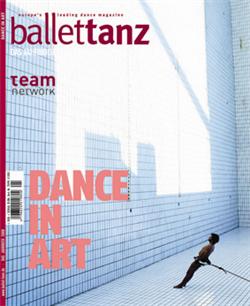
The use of the body as living raw material during a performance enables the artist to reduce the distance between himself and his art work. Even before any activity takes place, the body manifests itself in both a material and a temporal dimension by its simple presence. The arrival of performance art during the 1960s followed man’s desire to use the human form...
The dance project Landing08 took place at St Olavs Hospital in Trondheim, Norway. Part festival, part context-specific series of performances and stunts, the coalition of dance artists aimed to produce dance specifically for this context. Nine performances and four installations varied between site-specific dances utilising the hospital’s architecture, space and...
Jan Fabre, famous as you are, you do still very much like to take risks it seems.
It depends on what type of risk you are talking about: mental, physical or social risk. I often feel alone in the artistic landscape, because what I say, I do; what I make, I am. There are not many artists who are free to take risks, particularly in theatre. They are so steeped in...