Ein Brief aus Turin

Turin is traditionally linked to French culture, so it is not surprising that a few years after the huge success of the long-running Parisian show “Tango Argentino” by Claudio Segovia and Héctor Orezzoli, premiered in 1983 – a gorgeous revival of the early twentieth century wave of the typical Argentinian mix of music, song and dance, created in Paris – the Piemonte capital became “the” tango capital in Italy. The first association to promote and organize lessons, rehearsals and milongas in Turin was El Barrio Tanguero, led by Alfredo Petruzzelli, in 1990.
Barrio Tanguero started inviting “maestri” like Pedro Monteleone (Madonna’s coach for the film “Evita“) and Alejandro Aquino to teach and perform as well as top musicians such as Color Tango and Trio Esquina to play tango live. In 1994, then, the picturesque Café Procope Milonga was opened, a kind of French-style boîte de nuit, where it is now possible to dance in two different spaces, one devoted to classical tango and the other (the stalls of the Teatro Juvarra, cleared of chairs) to contemporary tango music from Piazzolla to Gotan Project pieces. The Barrio Tanguero also published a book on Carlos Gardel songs and a CD, “Dieci ...
Weiterlesen mit dem digitalen Monats-Abo
Sie sind bereits Abonnent von tanz? Loggen Sie sich hier ein

- Alle tanz-Artikel online lesen
- Zugang zum ePaper
- Lesegenuss auf allen Endgeräten
- Zugang zum Onlinearchiv von tanz
Sie können alle Vorteile des Abos
sofort nutzen
In David LaChappelle’s documentary, Rize, the pent-up rage of kids from Los Angeles’ South Central bursts off the screen and grabs you by the throat. But instead of violence, the anger takes shape in the exhilarating new dance forms called krumping and clowning. Clowning was invented out necessity and providence by an ex-drug dealer, Thomas Johnson (Tommy the...
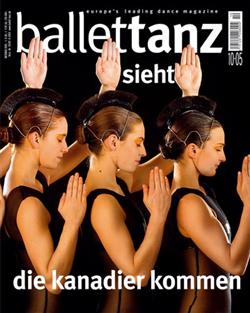
Aaron Watkin, ein weiter Weg. Sie stammen aus Vancouver, tanzten in Frankfurt und übernehmen 2006 als Nachfolger von Vladimir Derevianko die Ballettdirektion der Dresdner Semperoper. Warum Deutschland und nicht Kanada? Europa ist vergleichsweise klein, ohne Schwierigkeiten überwindet man die Grenzen, kann die verschiedensten Kompanien sehen,...
Alfred Döblin schrieb dem Ballett in «Die Tänzerin und der Leib» (1910) eine brutale Deformation des Körpers und damit der Seele zu. Ernst Jünger feierte umgekehrt in «Über den Schmerz» (1934) die Zurichtung des Körpers als das Ziel jeder Seele. Und Rainer Maria Rilke betrachtete den Tanz als eine Verwandlung, in der das Sichtbare endlich unsichtbar und geistig...