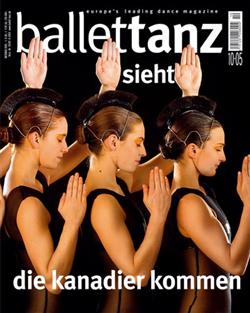
Isabelle Van Grimde

Why do we dance why do we dance why do we dance – why do we make our very fragile, inadequate bodies dance, our beautiful, intelligent, post-human bodies dance? Post-human or is it trans-human? I mean: Our decoded bodies choreographed within a context or without a context, yielding to the scrutiny of the spectator’s gaze … For freedom?
In the days of the decoded body, the encoded body, i. e. the trans-human or post-human body, why do we dance? Sometimes it seems that we are obsolete.
Sometimes when I watch dance performances I feel that we as choreographers are afraid that dance – that our bodies – are not enough, are inadequate and so we feel we must provide a context. We need to make sure that others see that we have ideas, that we can articulate things beyond the body and so we use theatre, new media, teachnology and hurl words across the space. We enlist the visual help of beautiful or fashionably mundane sets and the guidance of the almighty dramaturge. Through all of these dance has become the most powerful form of theatre in the 20th century … It’s great, but let me, for one moment, rebel against it!
Where is the power of the human body unadorned?
Thrusting ourselves in ...
Weiterlesen mit dem digitalen Monats-Abo
Sie sind bereits Abonnent von tanz? Loggen Sie sich hier ein

- Alle tanz-Artikel online lesen
- Zugang zum ePaper
- Lesegenuss auf allen Endgeräten
- Zugang zum Onlinearchiv von tanz
Sie können alle Vorteile des Abos
sofort nutzen
The recently-founded Dancer Stage Academy (DSA) in Amsterdam is offering a postgraduate program from September 2005. Artistic directors Valerie Valentine, a former ballerina with the Dutch National Ballet and founder of the Amsterdam-based studio Dance Street, and Yehuda Maor, former director of San Francisco Dance Theater and developer of the Maor Placement...
Aaron Watkin, ein weiter Weg. Sie stammen aus Vancouver, tanzten in Frankfurt und übernehmen 2006 als Nachfolger von Vladimir Derevianko die Ballettdirektion der Dresdner Semperoper. Warum Deutschland und nicht Kanada? Europa ist vergleichsweise klein, ohne Schwierigkeiten überwindet man die Grenzen, kann die verschiedensten Kompanien sehen,...
Imagine a selection of drawings, scores, instructions or sketches created by choreographers during the process of making dances, e. g. Trisha Brown, Yvonne Rainer, Dominique Bagouet, Remy Charlip, Mary Wigman, William Forsythe and Elisabeth Streb. How might we conceive of these as representations of choreographic thinking or as carriers of moving ideas? How would...