On risk

Jan Fabre, famous as you are, you do still very much like to take risks it seems.
It depends on what type of risk you are talking about: mental, physical or social risk. I often feel alone in the artistic landscape, because what I say, I do; what I make, I am. There are not many artists who are free to take risks, particularly in theatre. They are so steeped in the ideology of the system that they become too docile and accommodating.
Festival and theatre directors tend to say: ‘Please don’t shock my audience!’ Many artists are becoming compliant, getting audiences to leave the theatre on a happy note. It is a question of survival. Generally speaking, in theatre you don’t dare take risks as you might in the visual arts or in performance.
Is this because theatre involves a relationship with a group?
Of course. As a visual artist you create your work, and afterwards it enters an ideological system, a gallery or a museum. Most of the time in theatre, artists work already inside an ideological system which penetrates their work. You can somehow almost smell it.
Do you not feel that society is much more permissive today, though?
In the late 1970s and early 80s, the economic ...
Weiterlesen mit dem digitalen Monats-Abo
Sie sind bereits Abonnent von tanz? Loggen Sie sich hier ein
- Alle tanz-Artikel online lesen
- Zugang zum ePaper
- Lesegenuss auf allen Endgeräten
- Zugang zum Onlinearchiv von tanz
Sie können alle Vorteile des Abos
sofort nutzen
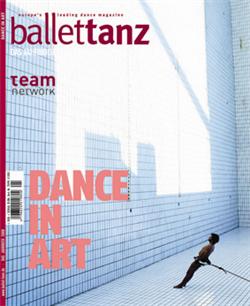
Urban Art is public art. Whether you are counting in sculptures in a park or a dance company’s act on a market place – art is examining our societal environment as well as our relationship with art and the real.
Of course, we dream – and how much the very word “dance” stirs the imagination – of a new Rimbaud who “stretches ropes from steeple to steeple,” or the...
Cisco Aznar
In seiner «Andrógena de Minas» meint eine Figur zynisch: «Der wahre zeitgenössische Künstler ist ein selbstsüchtiges, sich im Luxus tummelndes Biest. Einen Inhalt vermitteln? Ist doch Quatsch! Das machen Politiker besser. Die romantische Auffassung von Kunst ist überholt.» Nun wäre es falsch, daraus zu schließen, Cisco Aznar habe sich der Romantik...
The art of Tino Sehgal is unique. Without objects, such as paintings or sculptures, it cannot be considered an installation, and according to the artist, it is not performance.
Born in London 1976, Tino Sehgal, who lives and works in Berlin, received just recently the prestigious 80 000 Swiss Francs Zurich Art Prize. He is what we call a famous artist. But his...