Exterior dance
Urban Art is public art. Whether you are counting in sculptures in a park or a dance company’s act on a market place – art is examining our societal environment as well as our relationship with art and the real.
Of course, we dream – and how much the very word “dance” stirs the imagination – of a new Rimbaud who “stretches ropes from steeple to steeple,” or the unpredicted outbreak of drunken maenads in the conforming and ordinary city.
Dancing the city and dancing life; what a utopia! Sometimes, however, a show can shake the landscape around it and create a temporal parenthesis, suspended in the urban tumult. Sometimes the path of a few dancers may also disturb our functional routine, and make us suddenly attentive of the matter of which ground and wall are made, in accordance with our physical bodies in the surrounding space, and to the emptiness of its hindrances. In short, it gives us a taste of freedom. Perhaps this is a function of art regardless of the place.
Choreographer Daniel Dobbels expresses this more gravely, more politically when he writes, “A dancer cannot dance without having within himself the hope that all bodies might also be free to move.”
By venturing out to ...
Weiterlesen mit dem digitalen Monats-Abo
Sie sind bereits Abonnent von tanz? Loggen Sie sich hier ein
- Alle tanz-Artikel online lesen
- Zugang zum ePaper
- Lesegenuss auf allen Endgeräten
- Zugang zum Onlinearchiv von tanz
Sie können alle Vorteile des Abos
sofort nutzen
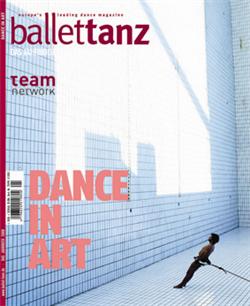
Welcome to our team!
TEAM stands for Transdisciplinary European Arts Magazines. For arts magazines that like to think outside the box. Not publications for specialists and insiders only, but good companions for a public with a genuine interest in the arts. Nobody is solely and exclusively interested in dance, visual arts, or music – each of those art forms is a...
Cisco Aznar
In seiner «Andrógena de Minas» meint eine Figur zynisch: «Der wahre zeitgenössische Künstler ist ein selbstsüchtiges, sich im Luxus tummelndes Biest. Einen Inhalt vermitteln? Ist doch Quatsch! Das machen Politiker besser. Die romantische Auffassung von Kunst ist überholt.» Nun wäre es falsch, daraus zu schließen, Cisco Aznar habe sich der Romantik...
Jan Fabre, famous as you are, you do still very much like to take risks it seems.
It depends on what type of risk you are talking about: mental, physical or social risk. I often feel alone in the artistic landscape, because what I say, I do; what I make, I am. There are not many artists who are free to take risks, particularly in theatre. They are so steeped in...