Utopia

“That spring day in 1994 on the Croatian island Krk was one of the most special days in my life,” says Marko Peljhan. On this island in the Kvarner Gulf, where there were practically no tourists in the first half of the 1990s, he – together with a team of co-workers with whom he was contemplating his third performance – set off for a location marked only by a signpost displaying a backpacked traveller and the words “The Way to the Moon.
” While they were hiking in an area reminiscent of the moon, military aircrafts flew over them and explosions from Lika (disputed region in Croatia) and Bosnia resounded in the north wind. “On that day, the war touched me in both a poetic and hyper-real way, and I said to myself, ‘If the structure of the world enables these explosions, then we have the following possibilities: 1) either a complete withdrawal into one’s own subjectivity, a sort of psycho-religious option, or 2) an embrace of the sort of ignorance that predominated the Slovene and broader European space at the time. Though perhaps a third possibility exists …’”
Marko Peljhan, who is a theatre director by training, got into art particularly through Russian constructivist Velimir ...
Weiterlesen mit dem digitalen Monats-Abo
Sie sind bereits Abonnent von tanz? Loggen Sie sich hier ein
- Alle tanz-Artikel online lesen
- Zugang zum ePaper
- Lesegenuss auf allen Endgeräten
- Zugang zum Onlinearchiv von tanz
Sie können alle Vorteile des Abos
sofort nutzen
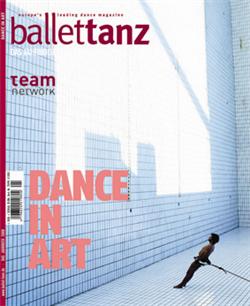
Some choreographic works are not understood until they are seen from an art-historical perspective, when their significance shows. This is true of VA Wölfl and Neuer Tanz, say, and especially so of Gerhard Bohner. Alone among choreographers, he linked the study of movement with investigations into space, line, colour, abstraction and art-philosophical concepts such...
Cisco Aznar
In seiner «Andrógena de Minas» meint eine Figur zynisch: «Der wahre zeitgenössische Künstler ist ein selbstsüchtiges, sich im Luxus tummelndes Biest. Einen Inhalt vermitteln? Ist doch Quatsch! Das machen Politiker besser. Die romantische Auffassung von Kunst ist überholt.» Nun wäre es falsch, daraus zu schließen, Cisco Aznar habe sich der Romantik...
Urban Art is public art. Whether you are counting in sculptures in a park or a dance company’s act on a market place – art is examining our societal environment as well as our relationship with art and the real.
Of course, we dream – and how much the very word “dance” stirs the imagination – of a new Rimbaud who “stretches ropes from steeple to steeple,” or the...