Black humour

La Ribot and Mathilde Monnier form a duo. Or, when burlesque takes revenge on art
They laugh and cry together like two teenage best friends, two sisters, two black swans in a pas de deux. Nobody believed the project could work.
La Ribot and Mathilde Monnier? Aren’t those two very different artistic worlds? Mathilde with her rotating groups, the embodiment of progress in movement, and who has recently been researching harmony (see ballet-tanz 6/07), and at the other extreme the Swiss-Spanish artist with her solitary performances, “distinguidas” through and through? On a superficial level, this seems to be the case. But what’s wrong with that? Someone who can create something with a writer or a pop singer, like Monnier can, can do the same with an artist. Someone who can pull off a piece with fifty amateurs producing roars of laughter from beginning to end (“40 espontáneos,” 2004) like La Ribot, should be able to establish a dialogue with an experienced choreographer.
Indeed their interests lie in comparable areas. La Ribot has symbolic concepts condensed into poses; Monnier has deconstruction and exploration of peripheries. “It’s true that we are very different,” says La ...
Weiterlesen mit dem digitalen Monats-Abo
Sie sind bereits Abonnent von tanz? Loggen Sie sich hier ein

- Alle tanz-Artikel online lesen
- Zugang zum ePaper
- Lesegenuss auf allen Endgeräten
- Zugang zum Onlinearchiv von tanz
Sie können alle Vorteile des Abos
sofort nutzen
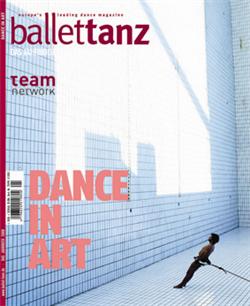
“I don’t like dance,” says Ben J. Riepe. The 29 year-old choreographer is serious: “The attitude, the affectation, the intrigues.” Dance has not yet realised its potential and is still hanging on to old ballet clichés. “Contemporary dance is all the same, simply awful,” he says scathingly, raising his voice a few decibels – not only because the Düsseldorf bar where...
«Thou shalt not kill», sagt der Tänzer Darryl E. Woods. Du sollst nicht töten. Auf der Bühne wird der Gashahn aufgedreht. Alle fallen in ein tiefes Koma. Dazu klingt 800 Jahre alte Musik, so entsetzlich fröhlich komponiert wie von Menschen, die die Kreuzzüge überlebt haben und nicht mehr wissen, ob sie nun bei den Engeln oder in der Hölle leben. Klar: Die Engel...
Some choreographic works are not understood until they are seen from an art-historical perspective, when their significance shows. This is true of VA Wölfl and Neuer Tanz, say, and especially so of Gerhard Bohner. Alone among choreographers, he linked the study of movement with investigations into space, line, colour, abstraction and art-philosophical concepts such...