Making magic with space and light
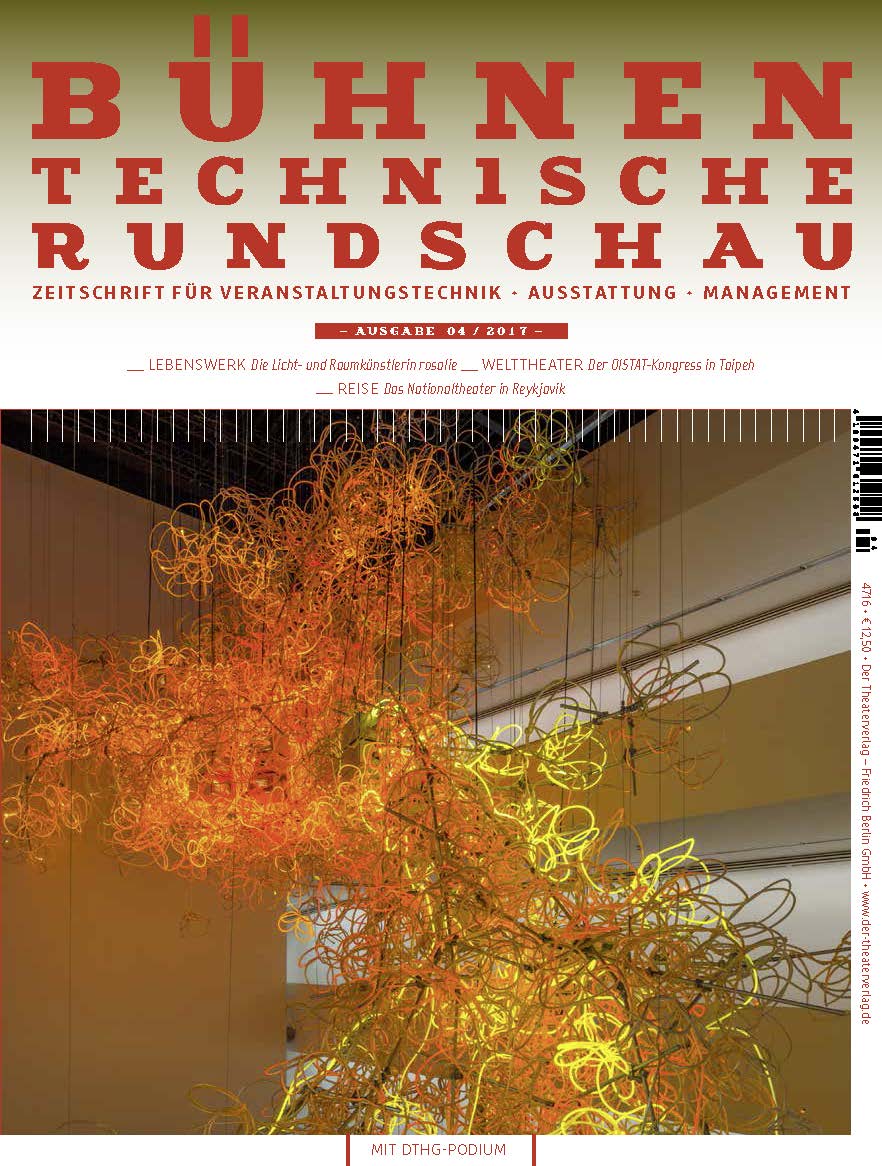
As reported in BTR 3/2017, stage and costume designer rosalie sadly passed away on 12 June. In this issue, her associate and friend Peter Weibel pays tribute to her and her ground-breaking work, which opened new perspectives on opera, dance and theatre.
Classic stage design belongs to the genre of spatial art, i.e. sculpture and architecture. But it also involves painting, i.e. visual art. The purpose of classic stage design is to create the scenes in which the action of the drama takes place.
But what are scenes? rosalie tackled this question with special artistry, by attributing visual, textual and musical elements equal importance within each scene. Her stage designs were like audio experiences for the eyes and visual experiences for the ears; spaces in which sculpture, spatial art, music and text could all resonate. Her productions gave voices to all the individual particles out of which an opera, drama or ballet consists. rosalie isolated the elements of opera and drama and made them into equal absolutes. What she did, then, was to interpret the light, or the sound, or the image. Then taking these artistically autonomous elements as a point of departure, she designed the stage. She transformed all the scenic elements into a new art form. She was the first woman in the world to design Wagner’s “Ring”. Her legendary production for Bayreuth ran from 1994 to 1998. A conventional stage designer would have installed a mimetic painting of the forest or simulated trees using two-dimensional cardboard figures, or transplanted real oak trees. But from the world of representation and objects, rosalie subtracted just the colour green, the colour of the forest. She shifted the perspective.
Drawing with light
In almost all her stage designs, she created an imago of light. Light became her preferred medium for creating stage art. She first singled out light from the stage design, and started working on autonomous light projects, in 1997. By the start of the 21st century, rosalie had become a light artist as well as a stage artist. From 2004 onwards, she created compositions out of neon light, and in 2007 she started using optical fibres, such as in the work “Helios” (2007). From the outset, light was a crucial element in rosalie’s stage design. As her stage idiom was so universal, it was a success in all disciplines – in opera, drama and ballet as well as a museum context. By using all media, even the latest innovations in light and computer technology, she ultimately created a new form of spatial art and a universal theatre of light. Light is a message from the universe. rosalie is a messenger of light.
BTR Ausgabe 4 2017
Rubrik: English texts, Seite 100
von Peter Weibel
From 1 to 9 July, the international community of creative, theatre-related professions met in Taipei for the OISTAT Congress. Embedded within Scenofest, it included numerous practical and theoretical workshops as well as the contests and exhibitions “World Stage Design”, “Theatre Invention Prize” and “Theatre Architecture Competition”. It was the largest international event our...
Die Steuerpulte und insbesondere deren Bedienoberfläche stellen die Verbindung zwischen Mensch und Maschine her. Mit der Mechanisierung der bühnentechnischen Einrichtungen hat sich die Arbeit der Maschinisten einschneidend geändert. Wie sollte eine Bedienoberfläche gestaltet sein, die einerseits die Komplexität der Arbeitsabläufe erfasst, gleichzeitig aber leicht bedienbar ist? Unsere...
Am 12. Juni verstarb die Bühnen- und Kostümbildnerin rosalie, wir veröffentlichten die traurige Nachricht in Heft 3. Peter Weibel, Freund und künstlerischer Begleiter, würdigt die Künstlerin als Wegbereiterin für einen neuen Blick auf Oper, Tanz und Theater. Sie hatte sich immer mehr von der Bühnen- zur Lichtkünstlerin entwickelt und für ihre Installationen und Bühnenräume mit neuartigen...