Appealing to the senses
Opera is a multi-sensory experience. Hearing, seeing, understanding – the heart and the mind are stimulated in equal measures by opera. This is impressively demonstrated by an exhibition now showing at the Victoria and Albert Museum in London. Presented as if it were a stage production itself, the show draws the public into the world of opera using modern multi-media technology. Back in Germany, an exhibition in Frankfurt’s Schirn gallery uses the same concept to immerse visitors in the world of the diorama.
And going back in time, the nativity play is one of the earliest forms of staging (historical) tales that has not only survived and diversified but continues to exert great popular appeal.
From the staged exhibition to the home of real opera: Opera houses, too, are stage-managed to stimulate the audiences’ senses and get them in the mood for the shows. Munich’s Gärtnerplatztheater has been spruced up and reopened in new splendor after five and-a-half years’ refurbishment. Following on from the ‘prelude’ at the Berlin State Opera, the curtain here, too, went up on a belated start to the season. To get the theatre back to its former glory, the skills of specialist craftsmen were called upon. Question is, does today’s public still appreciate this kind of traditional craftsmanship on a sensory level, or just perceive it as antiquated? While this continues to be a regular cause of controversy and debate, we shouldn’t forget that renovation aims not only to create more comfortable surroundings for the audience but also better working conditions for the staff. And that has been achieved at both the theatres profiled here – no question!
Appealing to the public’s senses – new ideas on how to achieve this are always popping up. ‘Theatre to smell’ is a recent innovation developed in cooperation with chemical scientists. Our sense of smell is directly linked to our unconscious. Just think of the immediate sensory response you have when you read a title like “Incense and Tar”! In this issue, we explore how past audiences must have perceived theatre, and how more sophisticated technology has changed our perception, by looking at the informative examples of the reconstructed theatres in Hellerau and Salzburg.
What happens behind the scenes to appeal to and enrich the audience’s senses? There are plenty more articles and ideas on the subject in this issue of BTR and in the enclosed “Podium”. For now, we wish you a sensational festive season and all the best for 2018!
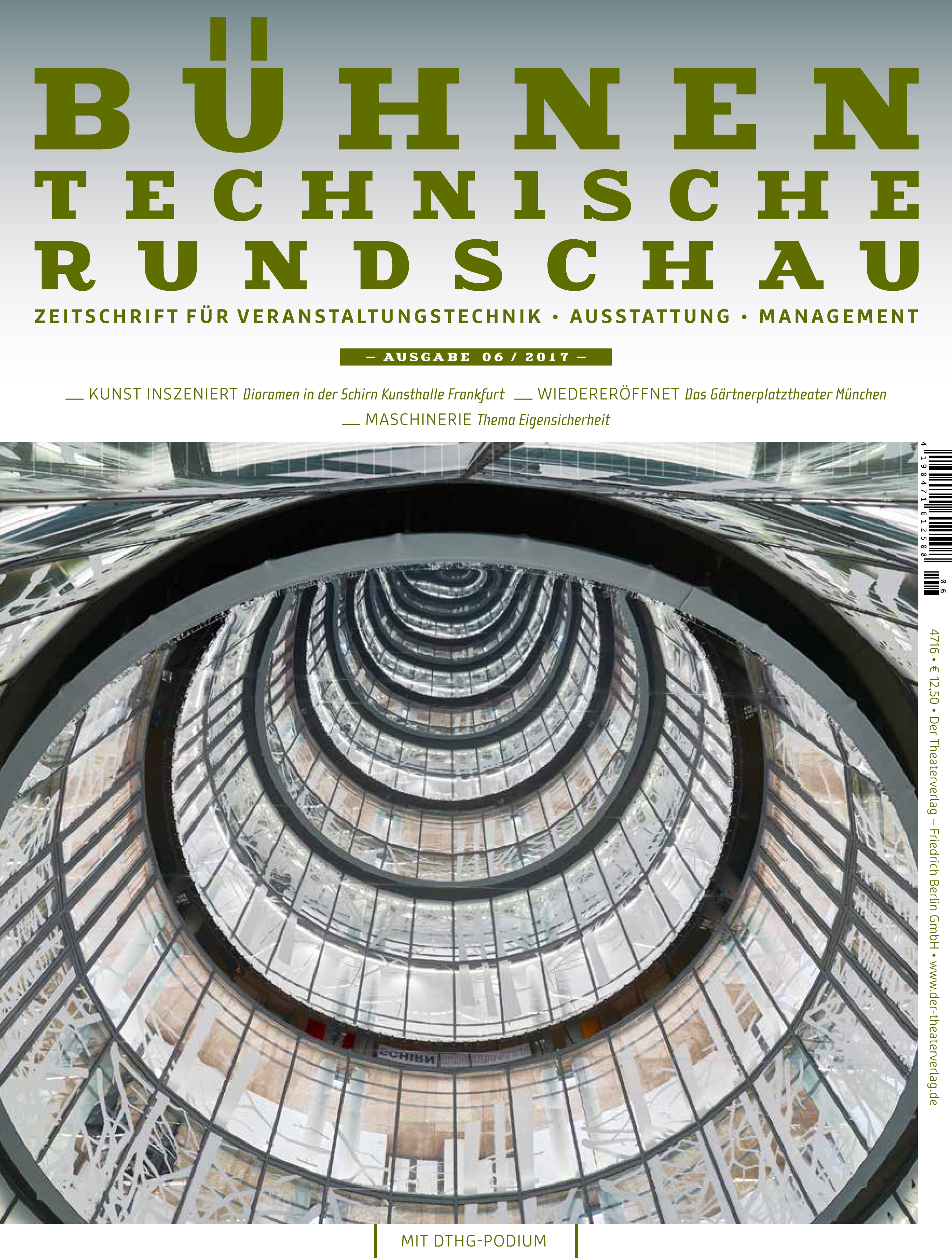
BTR Ausgabe 6 2017
Rubrik: English texts, Seite 203
von
The Salzburg Easter Festival, founded 50 years ago by Herbert von Karajan, was launched with a production of Wagner’s “Die Walküre”. To mark the half centenary, the current festival directors commissioned stage director Vera Nemirova to create a new production of the festival’s inaugural work using the original stage set by Günther Schneider-Siemssen. BTR talked to the makers to find out...
Dunst und Nebel sind auf der Bühne und im Film oft sehr wirkungsvolle Mittel, um die Dramatik von Szenen und die Lichtgestaltung zu unterstreichen. Auf welche Art wurden Nebel und Dunst für die Bühne erzeugt, wie sehen moderne Verfahren und Technik dafür aus? Welche Vor- und Nachteile bieten die unterschiedlichen Methoden? Der Autor hat zu diesem Thema einen Workshop bei der cast C....
Jeden Sommer begeistern die Bregenzer Festspiele die Besucher aus der ganzen Welt mit ihrer Oper auf der Seebühne und mit verschiedenen Inszenierungen im Festspielhaus. Vielen Bühnenbildnern und anderen Kreativen bietet sich in Bregenz ein Maximum an künstlerischer Freiheit. Mit der Software Vectorworks lassen sich ihre künstlerischen Skizzen und Ideen in technische Details und Fakten für...