Going under (stage) ground

The Greek director and stage designer Dimitris Papaioannou gained international renown with his production of the opening and closing ceremonies for the 2004 Olympic Games in Athens. Since then, he has become a firm fixture on the international theatre scene. With his fragmentary worlds of bodies and materials, he creates compelling images that really get under the viewer’s skin. His latest production “The Great Tamer” showed to great acclaim at the Festival of Avignon.
Do you remember the name of the man behind the opening and closing ceremonies at the Athens Olympic Games in 2004? Dimitris Papaioannou! If you watched them on TV, you won’t have forgotten the video-art frescoes and choreographies that Papaioannou used to translate the world of Greek gods and myths into a contemporary visual language. Thanks to the prestige this earned him in his home country, he is now one of the few artists in Athens to be able to bring major new productions to the stage. This summer, his production of “The Great Tamer” thrilled audiences at the Avignon Festival.
Following a series of large-scale productions, he now concentrated his efforts on achieving maximum effect by minimal means – partly in view of the difficult economic situation in his home country.
Underground
The story and scenography of “The Great Tamer” is based on a real-life tragedy that arose from the current troubles in Greek society. A teenage boy was stalked, pursued and chased by a group of other boys. Eventually his lifeless body was found under the ground. He had burrowed himself in – in a sense, buried himself – to escape the torment. The underground symbolism is introduced to the piece by an astronaut, who creates the perfect illusion of zero gravity. In this way, he transforms the stage into the imaginary surface of an extraterrestrial rock. Instead of reaching for the stars in the skies, he cuts into the ground and digs stones out. Again and again, actors fall into the ground and have to be “rescued”. Or they emerge from it, in a seemingly endless chain of underground dwellers. This is where Narcissus and Demeter dwell, and find water or volcanic ash under the broken-up rocks. Papaioannou built a slope to cover the entire plateau, over a metre high at the back edge of the stage. As we gradually realize during the course of the play, the surface is made of a few pliable rubber panels and many more rigid wooden panels. The former, painted white, can be turned round to look like two beach towels on the dark grey slope. The advantage of the wooden panels is their loud cracking when they are broken underfoot. That is intentional, of course, as under the stage there is another, invisible choreography taking place.
In the beginning was the sketch
In conversation with BTR, Papaiannou explained that he started off with some sketches, drawings and images, which became concretized over time. He and the actors conducted improvisation and research to keep generating new images from their bodies, the set and materials. Indeed, Papaiannou only ever makes notes in the form of sketches. He does not decide on a name or a title until shortly before completion. Perhaps the richness and power of his imagery lies in precisely this lack of words, BTR asked. Papaiannou responded: “I see myself as a writer and a painter, with the stage as my medium. I paint, draw and photograph. What I show people is only part of my creativity. I need visual composition to survive.”
BTR Ausgabe 5 2017
Rubrik: English texts, Seite 134
von Thomas Hahn
Ein elisabethanisches Theater, das den Ärmelkanal überquert, um sich in Frankreich niederzulassen, das ist ungewöhnlich. Das Kulturzentrum „L’Entente cordiale“ (freundschaftliche Verständigung), das im Schloss von Hardelot eingerichtet wurde, baute für sein Sommerfestival stets temporäre Theater. Nun wurde ein fester Holzbau errichtet. Als Hommage an die französisch-englischen Beziehungen...
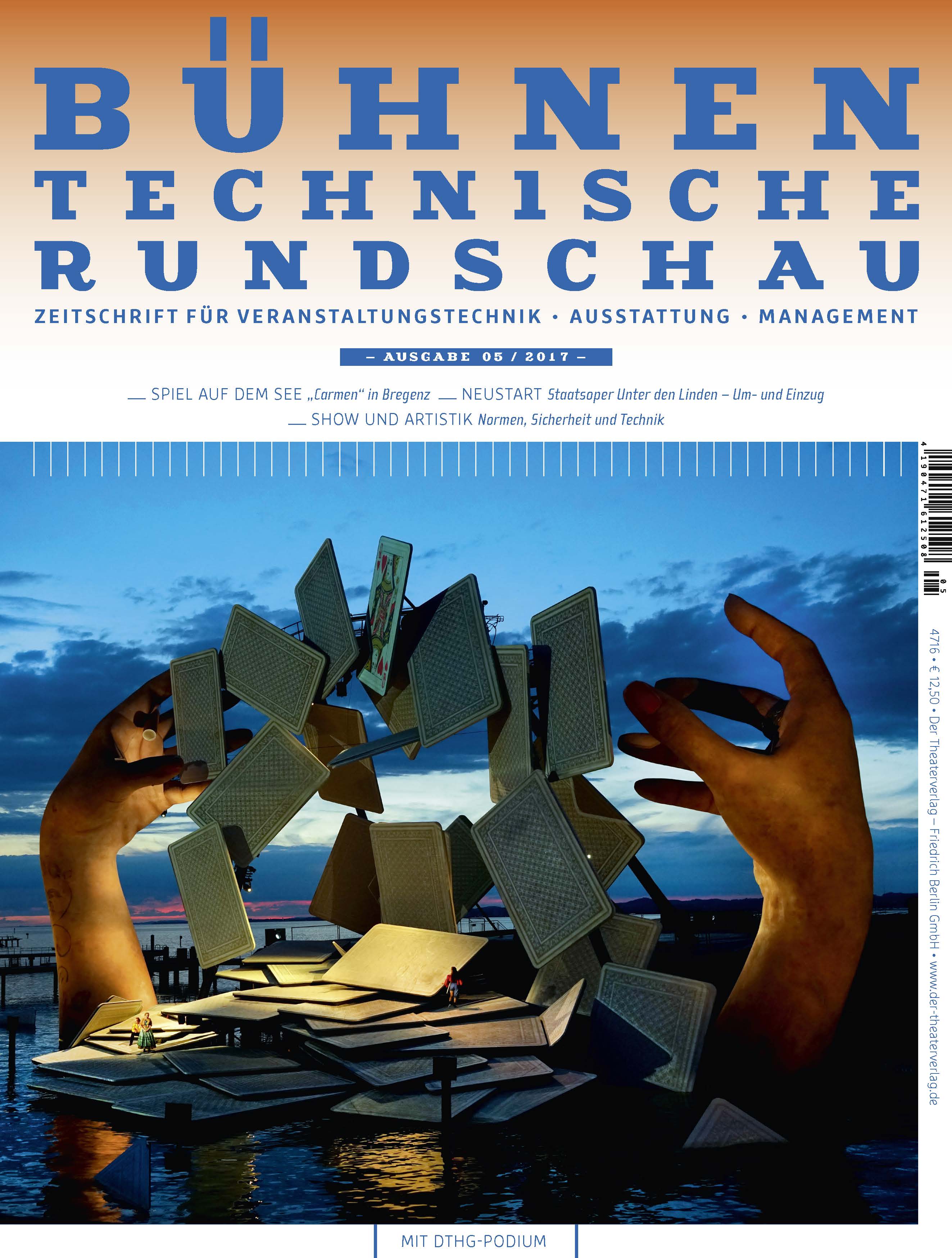
This year saw the 72nd edition of the Bregenz Festival. Once again, the lake stage proved a magnet for the public. Here, a production of Georges Bizet’s “Carmen” was attended by almost 7000 festival guests each evening, delighting them not only with its music and song but also with its extraordinary setting and effective projections.
Two enormous hands framing giant playing cards that...
Ernst Ludwig Kirchner, einer der bedeutendsten Künstler und Vertreter des Expressionismus des 20. Jahrhunderts, hat auch Theaterkulissen gemalt. In einer Sonderausstellung zeigt das Kirchner Museum Davos diese über 80-jährigen Auftragsarbeiten und bringt deren Kopien beim schweizerischen Volksstück „Die Tochter vom Arvenhof oder Wie auch wir vergeben“ zur Geltung – wie einst darf während...