Editorial
Cooperation
Working in teams, creating alliances, exchanging ideas: Together we can achieve more – this realization runs through all our reports on the summer’s events. The keyword alliance is taken up by Marc Grandmontagne, managing director of the German theatre association Deutscher Bühnenverein, in our interview: To keep the theatre landscape in Germany alive, everyone involved should meet and talk, he urges, even if they do not all have the same interests. Joint efforts must be made to ensure successful work in theatre.
Issues of renovation and finding qualified specialists concern everyone, and the BTT was once again a productive forum for discussing these and other subjects, including the latest technological innovations.
The International Theatre Engineering and Architecture Conference, ITEAC, ventured a look ahead to the future. Is there an ideal theatre? How can theatres be made fit for the future? Which technologies and architectural designs will appeal to young people enough to get them interested in theatre and opera? The conference once again provided a good opportunity to question old habits and find new perspectives. That has always been the aim of OISTAT, which celebrates its 50th anniversary this year. See the enclosed copy of Podium for a review of OISTAT’s first half-century. Also featured in this issue of BTR is an interview with Dr. Joel Rubin, one of the co-founders and the second president of OISTAT, an organization that has always held to the principle of reciprocal learning as an ongoing, vital project.
https://www.der-theaterverlag.de/Of course, we haven’t forgotten to review the latest events. In this issue, we look at some exhibitions featuring interesting medial and dramatic elements. The Manifesta art exhibition in Palermo is especially impressive. It turns the whole city into a stage, including the usually neglected parts, where it hopes to spread optimism among the people.
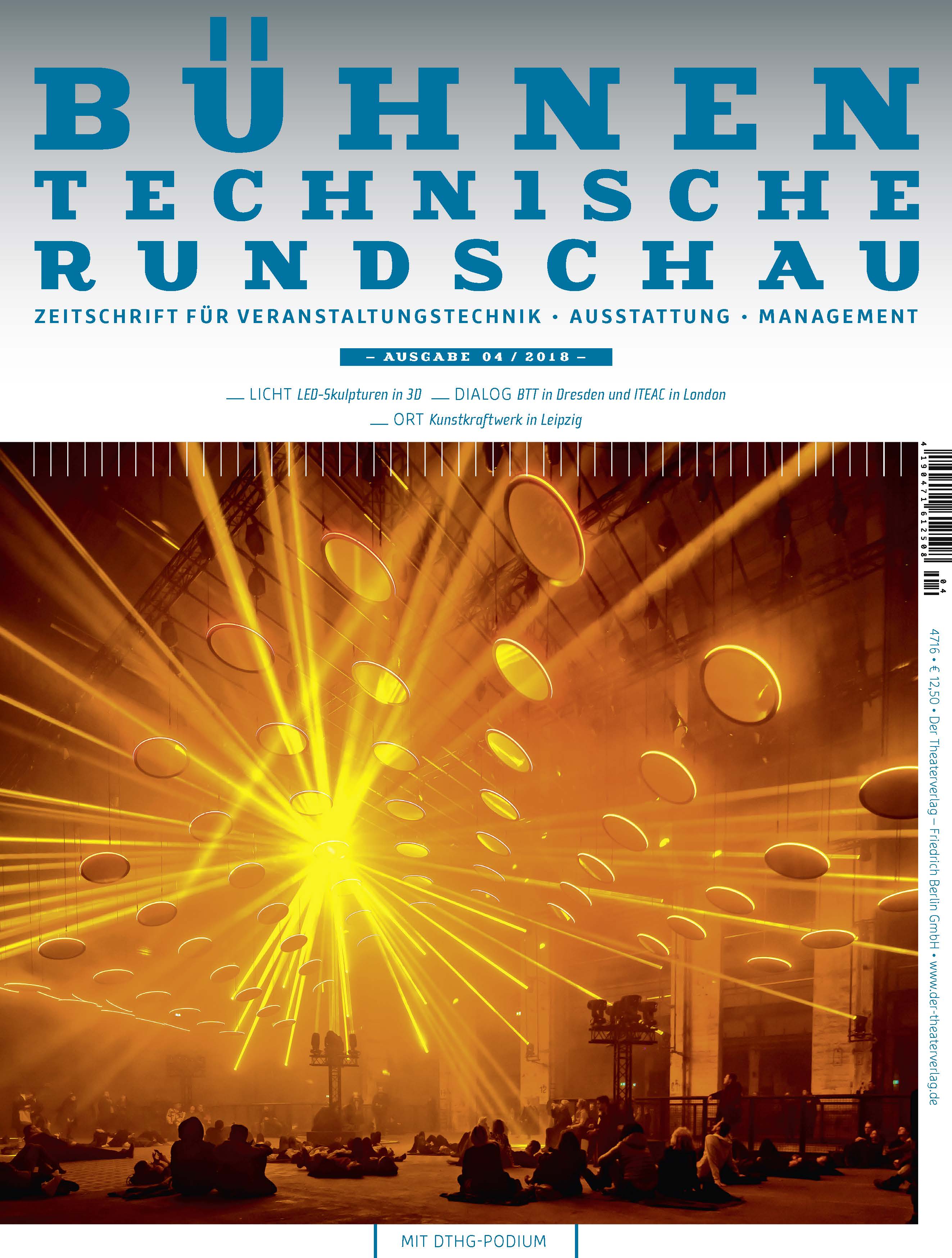
That was also what Walter Felsenstein set out to do when he re-founded Berlin’s Komische Oper in 1947, after the war. In its 70th anniversary season, the opera house paid special tribute to his work. Remembering is important but moving forward even more so. A good example is the venue Kunstkraftwerk Leipzig. Though only in its 3rd year, it has managed to breathe new life into a disused industrial area with some extraordinary projects.
The enclosed copy of Podium also brings our theme of alliance and cooperation full circle, containing the latest information on IGVW and ETTE, or the new network for beginners, aiming to help young people start careers in theatre.
As the hot summer fades into memory, we wish you a ‘cool’ start to the new season!
The Editors
BTR Ausgabe 4 2018
Rubrik: English texts, Seite 201
von
Im „Savoy Place“, dem Sitz der Institution of Engineering and Technology (IET) an der Themse, trafen sich vom 3. bis zum 5. Juni gut 300 Fachleute aus aller Welt, um aktuelle Tendenzen in Theaterbau und -technik zu diskutieren. „Orte für Veranstaltungen: Neue Richtungen“ war diesmal der Titel der vierjährlichen Konferenz, die ein vielseitiges Programm bot. Ein Bericht über die Planung und...
From 3 to 5 June, some 300 specialists from all over the world met in Savoy Place, the seat of the 1871-founded Institution of Engineering and Technology (IET), to discuss tendencies in theatre engineering and technology. ‘Places for performance – new directions’ was the motto of this year’s conference, which offered a compellingly varied programme.
As in previous years, the 5th edition...
Die vergangene Saison der Komischen Oper in Berlin war dem 70-jährigen Jubiläum des Hauses gewidmet. Mit zahlreichen Premieren zeigte es sich zwar höchst gegenwärtig, aber als Rückgriffe auf die Geschichte wählte Intendant Barrie Kosky die Produktionen „Anatevka“ und „Blaubart“ als Schwerpunkte aus, weil sie in der Geschichte des Hauses eine besondere Rolle spielten. „Anatevka“...